Bill “Mr. Ocean Liner” Miller recalls “QE2”

Bill “Mr. Ocean Liner” Miller recalls “QE2”

Bill “Mr. Ocean Liner” Miller recalls a memorable crossing onboard the “QE2” in July 1986.

It is surely the most glamorously nostalgic voyage of all – crossing the historic North Atlantic aboard the last of the so-called transocean super- ships, Cunard’s Queen Elizabeth 2. Almost all of the passengers were, in contrast to leisurely cruising, being transported – luxuriously transported, for the most part – from one continent to another. Unlike cruise voyages (which the Queen also runs), the crossing has a definite sense of purpose, a very real destination. My journey was slightly different, however. I traveled on a roundtrip: 5 days over, one night in England and then 5 days homeward.

When I boarded the QE2, as she is surely best known, at New York, she had just returned from her longest and most profitable charter yet, a special sailing from Southampton to New York via Bermuda, and then a “grandstand” anchorage in New York’s Lower Bay for the gala Fourth of July-Liberty Weekend celebrations. She had been chartered by Lee Iacocca, who had presided over the Statue of Liberty’s facelift and restoration fund-raising campaign, in his fulltime capacity as chairman of the Chrysler Corporation. Some 1,500 guests, most of them car dealers who had far and away exceeded their sales quotas, were invited for what was billed as “a caviar-filled, Champagne-flowing” trip. Robin Davies, the ship’s assistant hotel manager, was aboard for this special sailing and played an important part in the detailed planning.

“There were luncheon buffets and midnight buffets every day as well as an endless stream of special cocktail parties. The planning and preparation was enormous and even included a daily drink that bore an appropriate automotive name: Sundance, Shadow, Charger, Le Baron and Lancer. The passengers had been to Paris, a trip that included a special luncheon party at Versailles, and were then flown to London before being brought down to Southampton to join the ship. We had a special detour to Bermuda and a day there at anchor, when Mr Iacocca left the ship to fly onward to New York and prepare for the Liberty celebrations. Once at New York, the ship spent two days at anchor in Gravesend Bay. Champagne was served constantly on the open decks. We had perfect viewing for the Tall Ships parade and then the nighttime fireworks. Appropriately, we were anchored next to the largest representative from our Royal Navy, the aircraft carrier HMS Ark Royal.”

On the Atlantic voyage, the Queen had resumed commercial service and departed on an eastbound passage from her Hudson River berth with 1,550 passengers, 14 cars, 3 dogs and 2 cats on board. It would be her 586th voyage since being commissioned in the spring of 1969. Built at Clydebank in Scotland by John Brown & Company Limited (which in those fading years of British shipbuilding had become Upper Clyde Shipbuilders), she was royally launched and highly publicized from the start, and was clearly a dramartically different successor to the two previous Cunard Queens, the immortal Queen Mary and the first Queen Elizabeth, which had run the weekly trans-Atlantic shuttle since 1947.

Today, the Queen Elizabth 2 is, I believe, the most famous liner on earth. It is a combination, in uncertain quantities, of her illustrious heritage (there has been no grander name in Atlantic passenger shipping than Cunard) and her own, quite distinct personality. John Butt, her executive cruise director, adds, “She is, of course, the last of an era, a very glorious era. There will never again be another like her. She makes news wherever she goes, grabs attention and offers her passengers a vacation of a lifetime. Furthermore, there have been some very noticeable injections of pride into the ship. The old-timers among the staff are setting a very fine example to the younger crew members. Like Chrysler, we’re bringing the Queen back!”


Maritime Memories from Bill Miller

Maritime Memory Lane!  David Perry was a ship’s officer (on gold-plated Crystal Cruises) and went on to become a shoreside media tycoon (yes, from the printed word to TV host).   A dear friend, we co-lectured on a Maritime/Ocean Liner Nostalgia cruise (from San Diego southward to New Zealand onboard the Crystal Symphony) back in 2014.   These days, David is himself a hugely successful shipboard speaker (onboard the likes of Seabourn & Holland America) and so wonderfully & expertly carries the torch of maritime history.  Yes, he is eloquent, well researched, impeccably stylized.  Recently, he reached into his shoebox of travel photos & found the views below:

Image
Image

Not just a handsome face, Alfredo Casuso (left) created the billmilleratsea  website

Image

2nd seating:  Crystal dinnertime friends

Image

I was King Neptune during the Crossing-of-the-Line ceremonies & with my trident ordered that even the captain be dunked!

Image

Just had a post card from David & Alfredo from a Seabourn cruise in Panama (but below they are seen in Casa Martín 1920 in Grazalema, Spain)

Image

Cruise of the Kings

Cruise of the Kings

— by Bill “Mr. Ocean Liner” Miller

Screenshot

Royal Voyage!  Even the exiled king & queen of Italy were together with their four children when they took part in the Mediterranean/Greek isles cruise purposely organized by Queen Frederica and her husband King Paul of Greecein 1954. It became known as the “Cruise of the Kings”.  It was attended by over 100 royals from all over Europe. But since the ship’s voyage began in Naples, the Italian royal family could only board later, in Corfu in Greece, as they were not allowed to set foot on Italian soil. Nevertheless, on this trip, their daughter Princess Maria Pia met her future husband, Prince Alexander of Yugoslavia.   After all, the cruise was partly meant by Queen Frederica to be “royal meet and match”.

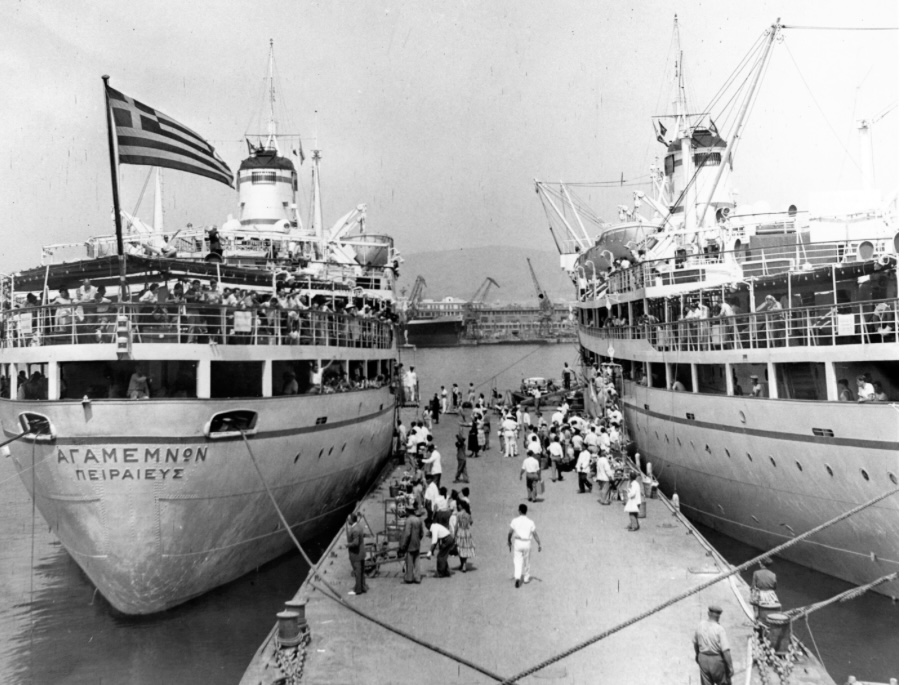
The year-old, 5,500-ton Agamemnon (seen below on the left), built at Genoa in 1953 as wartime reparations to Greece, and its twin sister Achilleus, were created purposely for regular service across the Eastern Med – alternating from Venice to Brindisi, Piraeus, Alexandria, Limassol, Beirut, Alexandria, Piraeus, Naples & Marseilles and then reversing.   

Screenshot

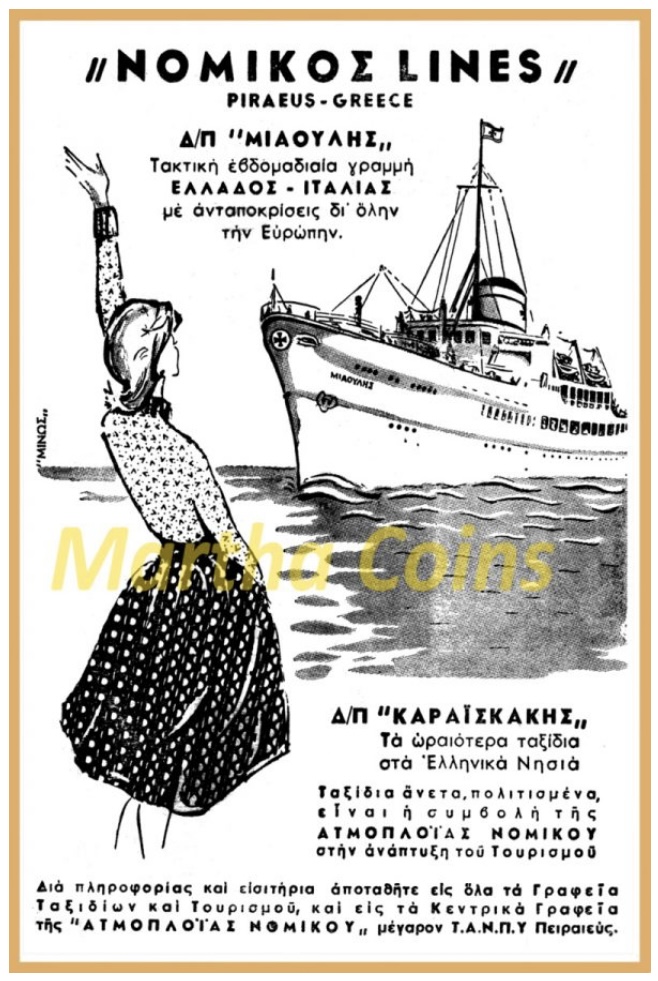
Accurately, the 416-ft long sisters were hardly overly luxurious, but they were comfortable. They were owned by shipping tycoon Petros Nomikos (the Nomikos Lines), a loyal friend to the Greek king and queen.   He canceled a regular voyage and chartered the 17-knot ship to the royal couple.  

The Second World War had “ruptured” relations between Europe’s royal families and so German-born Queen Frederica (she was a granddaughter of the last Kaiser, in fact) saw it an ocean-going “reunion”.   

Furthermore, as European tourism resumed, the strong-willed Queen wanted to promote Greece as a tourist destination.   The cruise was actually underwritten by monies the late shipownerEugen Eugenides (Home Lines) had left Frederica for the promotion of “international tourism in Greece”.  Frederica also saw the cruise as a way that enabled young European royals to meet & perhaps marry.

The two Nomikos passenger ships normally carried just over 400 passengers – 150 in first class, 150 in second class and 100 in lower-deck tourist class.   Each ship had 5 suites with full bathrooms and sitting rooms;   otherwise, only some of the remaining first class cabins had private shower & toilet only and none in second class. How the royals were assigned their accommodation is uncertain.  But there was no shortage on the guest list.

Altogether, there were 104 royals – some quite junior, others quite elderly – onboard.   The British royal family was among those that politely declined, but the likes of Queen Juliana of the Netherlands (and the future Dutch queen, Princess Beatrix) happily accepted.  So did Grand Duchess Charlotte of Luxembourg.   The Swedish & Danish royal families joined with the former kings of Rumania, Bulgaria and aforementioned Italy.  

Then there were long lists of princes & princesses, dukes & duchesses and below.   Dining room table assignments were changed each day as well as well-planned shore excursions in each port. The full itinerary read:  Marseilles, Naples, Corfu, Rhodes, Santorini, Mykonos, Skiathos, Cape Sounion and finally Piraeus (for Athens).  

The cruise was dubbed successful and repeated two years later, but on sistership Achilleus.  

Post Script:   Just in case, you are interested further:  In 1958, the Agamemnon & Achilleuswere sold to Olympic Cruises, a new cruise firm created by another Greek tycoon:  Aristotle Onassis.     But it was rather shortlived:   Onassis pulled out of cruising in 1963 and the ships were sold to Dorian Cruises, also Greek.

The Agamemnon capsized at her Piraeus berth in 1968.   Later salvaged, she was laid-up and then scrapped in 1974.  The Achilleus was  soldto Kavounides Shipping Company in 1968 and refitted as their Orion (seen below).  It was scrapped in 1998.

Screenshot

Happy Birthday Crystal Harmony / Asuka II

Happy Birthday Crystal Harmony / Asuka II

Ahoy! Today’s “Millergram” from the great Bill “Mr. Ocean Liner” Miller brought back so many happy memories: noting as it did the 35th birthday of my “first ship”, Crystal Harmony” (now Asuka II). In 1990, Kirk Frederick hired me to “help out” on a Christmas Cruise aboard “Harmony” and I was hooked. In 1998 and ‘99 I shipped out on her younger sister Crystal Symphony. It was there on deck “ship spotting” that I met Bill (many of whose books I already treasured), leading to a friendship as strong as anchor chains.

In 2000, Alfredo and I sailed (and worked) together aboard “Symphony” followed by another joint stint on “Harmony” to Mexico in 2001. Then, in 2014 we lectured our way across the Pacific with Bill Miller on “Symphony.” Those two sisters have been a big part of our life!

Ahoy and thank you Kirk and Bill! And, of course, without these two ships, Alfredo and I would not have met.

—————————

6 October 2025: Bill Miller’s “Millergram.”

Screenshot

Anniversary!  The late Mary Tyler Moore would be proud – the Asuka II turned 35 in July. The ship, operated by Japan’s NYK Cruises, is the former Crystal Harmony.  Ms Moore was the ship’s godmother back then, in June 1990, the very start-up of elegant Crystal Cruises. At the time, the 960-bed, Japanese-built Harmony was often described as the “most luxurious cruise ship yet built”.   It was  transferred in 2005 by then NYK-owned Crystal to fulltime Japanese cruise service.

We had the first of many cruises on the Harmony back in Aug 1990.   The ship was absolutely impeccable!  And we were aboard the ship’s final cruise under the Crystal houseflag (to Alaska out of San Francisco) in the summer of 2005.  

Bill Miller “Mr. Ocean Liner” with a Rare Magazine “SS United States” Cover

Bill Miller “Mr. Ocean Liner” with a Rare Magazine “SS United States” Cover

SCRIBBLINGS
From Bill Miller

C:\Users\bill\Pictures\Tony117\Aug 01 2021\Ships Color Done\CARINTHIA in Montreal (2).jpg

The Carinthia at Montreal

Sat Jun 21st At Home:  Memories Soviet Style!  Back in the mid 1960s, Graham Lees served aboard Cunard’s Carinthia and on the Liverpool-Montreal route.  Our recent posting on the Alexandr Pushkin/Marco Polo prompted memories of that ship.  “Whilst in Montreal on one of my scheduled 3 night stays each 3rd week of the Carinthia season, some of junior officers went on board the Pushkin [seen below at Sydney] to have a look around,” he wrote. “It was very basic in most of the accommodation – a lot of cabins not having a bathroom, merely a sink which had to be filled and emptied using a supplied pitcher from somewhere along the alleyway. Posh cabins were more appropriately supplied with bathrooms which, I seem to remember, had a bath but no shower. Some vodka was consumed! We invited some of the Russian officers back on board the Carinthia and they were impressed with the passenger and especially the officer accommodation.” 

Alexandr Pushkin - Prymont

He added, “Some years later, a former student of mine served as electro-technical officer on board the Marco Polo and he was pleased to inform me that the ship was no longer in the condition it had formerly been. He enjoyed the years he spent there and I actually went to the pier head in Liverpool to see her. CMV used Liverpool as a turn-around port in those days.”

IMG_9133
IMG_9216

Above:  The Marco Polo at St Petersburg in May 2015

Red, White & Blue!  Richard Weiss wrote: “Sorting through some miscellaneous ship stuff the other day [Jun 5th], I came across this issue of Science Illustrated from May 1949. It shows the unmistakable profile of the United States  and with a short article on the pros and cons of operating a big liner and comparing the statistics of passenger loads etc. of the new American liner vs the already successful Cunard Queens. The first page shows a picture of the new ship with William Francis Gibbs looking it over. What is odd is that in this model as well as the cover picture shows the funnels silver for the lower half and above that the traditional colors of United States Lines RW&B. Apparently a name for the new super liner had not been chosen at this time as the author suggested calling her the SS American Engineer due to Mr. Gibbs extraordinary record as a naval architect. This is the earliest publication I have ever seen on the ship and brings up the question of when exactly did she receive the name United States?”