Aomori: An Historic Ferry, Nebuta and Clean, Quiet Streets
Aomori: An Historic Ferry, Nebuta and Clean, Quiet Streets
— David Eugene Perry
25 September 2026: Ahoy! Alfredo and I spent the day walking around Aomori, beginning along the waterfront near the preserved Hakkodamaru, the former Seikan railway ferry that once carried passengers, freight and entire railway cars between Honshu and Hokkaido.
Along the waterfront we stopped at signs explaining Aomori’s connection to Marine Day. In 1876, Emperor Meiji departed Aomori aboard the lighthouse tender Meiji-maru, reaching Yokohama four days later. The voyage was commemorated with the establishment of Marine Memorial Day in 1941; in 1996 it became the national holiday now known as Marine Day.
We also passed Shōtoku Park, which commemorates Emperor Meiji’s visits to Aomori in 1876 and 1881. The park has been moved several times as Aomori Port expanded and the Bay Bridge was constructed.
From there we approached the Hakkodamaruitself, first seeing the ship across the harbor and then the surviving railway tracks leading directly toward its stern. Inside, the museum preserves exhibits on the old Seikan ferry service, including models of earlier vessels and displays showing how passengers traveled aboard them.
One of the most sobering exhibits concerned the Tōya Maru disaster of September 26, 1954. When Typhoon No. 15 struck northern Japan, five Seikan ferries sank, including Tōya Maru. About 1,430 people were killed. The disaster accelerated the push to build a fixed connection beneath the Tsugaru Strait, eventually resulting in the Seikan Tunnel, which opened in 1988.
We continued through the preserved passenger areas, the bridge, and the engine room. A display on the bridge showed cruise ships that called at Aomori in 2019, including Westerdam, our own ship. From the bridge we could look across the harbor and see Westerdam itself.
Below decks, the old railway tracks remain in place where trains once rolled directly aboard the ferry. Today part of that space is also used for art installations, including contemporary works using Nebuta techniques and illuminated paper forms.
After leaving the ship we went into A-FACTORY, a large waterfront market and food hall specializing in Aomori products. Apples dominate the shelves, along with cider, juices, sweets and other regional specialties.
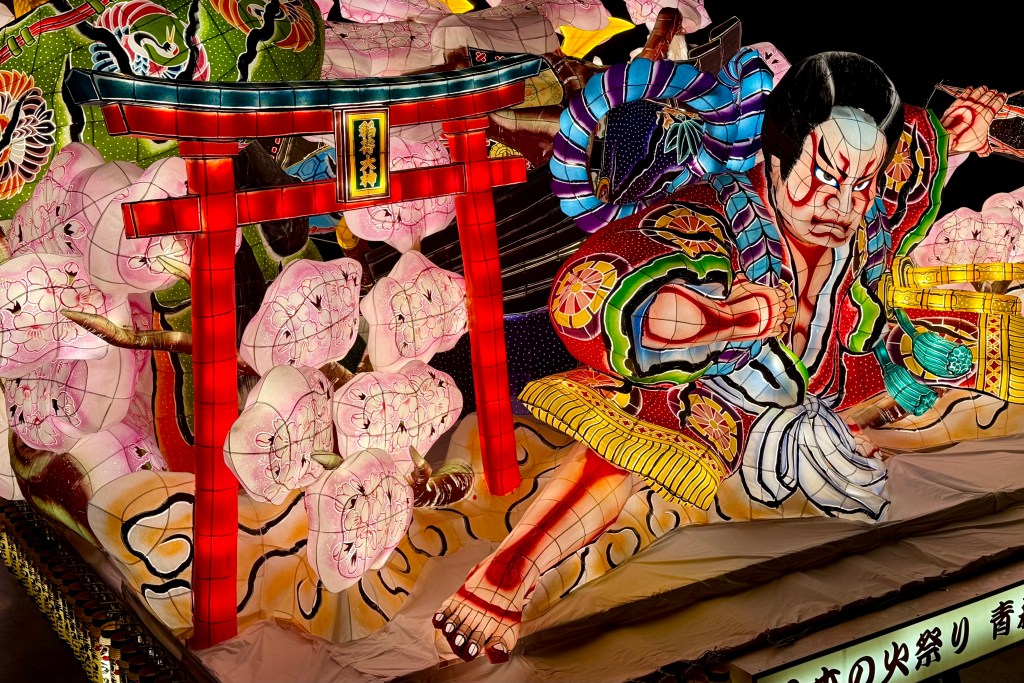
Our next stop was the Nebuta Museum Wa Rasse, devoted to Aomori’s famous Nebuta Festival. Near the entrance were smaller illuminated figures, including a “Welcome to Warasse” display. Inside the main hall were full-size Nebuta floats made of painted paper stretched over internal frames and illuminated from within.
The floats depict warriors, deities, animals and scenes from Japanese legend. One display told the story of Kiyohime, who, after being betrayed by the monk Anchin, transforms into a giant serpent and pursues him to Dōjō-ji Temple. Another section explained how contemporary Nebuta artists reinterpret traditional techniques while keeping the same basic construction of paper, wire, wood and light.
In the gift shop we found something unexpected: JMSDF Ōminato Curry, boxed curry based on recipes associated with ships of the Japan Maritime Self-Defense Force stationed at Ōminato in Aomori Prefecture. Two boxes featured the destroyer Yūdachiand the escort ship Ōyodo.
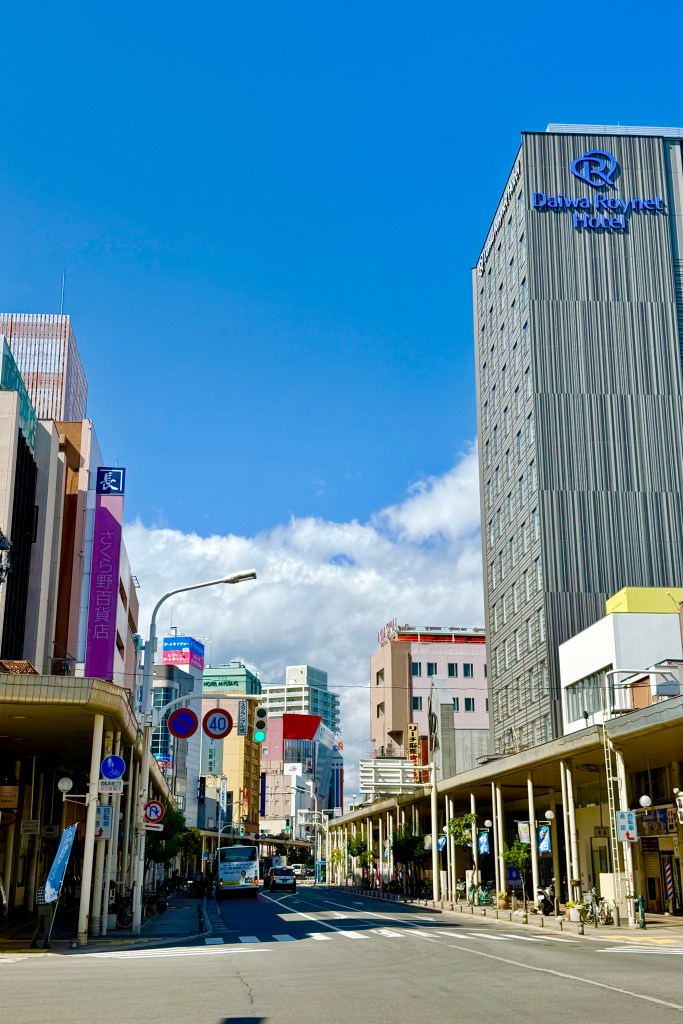
Leaving the museum, we walked down Shinmachi Shopping Street. We were surprised to see so much of the sidewalk protected by overhead coverings. Given Aomori’s heavy winter snowfall, these covered walkways make more sense as protection from snow and bad weather than from the sun.
We tried several ATMs without success before finally finding one that accepted my card at a Lawson convenience store. Lawson is one of Japan’s major convenience-store chains and a principal competitor to 7-Eleven.
We also stopped briefly in a 7-Eleven, having heard so much about Japanese convenience stores. Along the way we noticed Halloween merchandise in a shop window, one more example of how thoroughly certain Western and American holidays have been absorbed into Japanese retail culture.
One thing that continued to strike us was how quiet and orderly the city felt. The streets and sidewalks were impeccably clean; we literally did not see a piece of trash. At the same time, public trash cans were almost nonexistent. Japan has a strong custom of people carrying their own rubbish until they can dispose of it properly.
Public restrooms were similarly remarkable: whether in museums, parks or other public facilities, every one we used was extraordinarily clean. What we did not often find were paper towels. Many Japanese people carry a small handkerchief or towel for drying their hands.
Mask wearing was also still very common. Japan’s mask culture long predates COVID, with modern widespread use dating back to the 1918 influenza pandemic and later becoming common during flu season and for protection against pollen.
As we continued walking, we repeatedly noticed the distinctive red-and-white steel lattice communications towers that rise above Japanese cities. Their open framework and antenna platforms immediately reminded me of the countless Godzilla films in which such towers seem destined to be knocked down.
While I stopped to photograph one of them, a dragonfly landed on my arm and stayed there long enough for a photograph: a good omen for the rest of our Japanese visit I thought.
We also came across Kaneu Inari Shrine, a small shrine associated with prosperity, commerce and good fortune. Its sign explains that it dates to 1838 and honors Inari deities connected with agriculture, business and wealth.
A little farther along we finally found a pub: Cafe Bar Atom, advertising itself as “American & Irish.” Like the other bars we had passed, however, it was closed. Outside were Guinness signs, American and Irish decorations, Hello Kitty figures and a vintage poster for the Rita Hayworth and Glenn Ford film Affair in Trinidad.
Now, 15,000 steps later we return to the good ship Westerdam. By then we had spent several hours walking through a city where maritime history, modern Japanese culture and Aomori’s own regional identity were all visible within a relatively small area.