Art, History and a Search for Santa’s Mailbox
Ahoy! Art, History and a Search for Santa’s Mailbox in Nuuk, Greenland
by David Eugene Perry
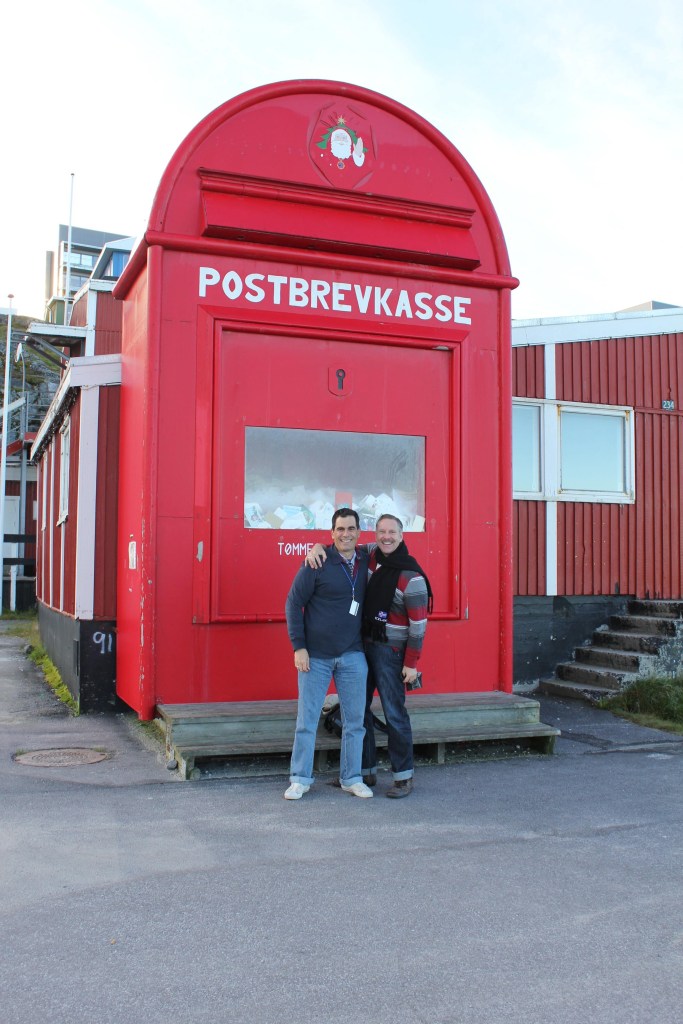
8 August 2026: Ahoy from Nuuk, Greenland! Today, Alfredo and I walked about town – our first visit since 2010. What can we say – the town has grown! When we were here 16 years ago, the city had around 15,000 residents. That has now expanded to over 20,000 with a slew of new buildings. We started our walk-about in search of “Santa’s Mail Box”: A giant red post box which is “The Official Address for the North Pole.” More about that anon.
As we strolled on this clear but pleasantly cool day, we came across several historic statues and the Icelandic Consulate.
King Frederik IX and Queen Ingrid — 12 July 1952. This simple stone commemorates the Danish royal couple’s visit to Greenland in 1952. Frederik IX was King of Denmark from 1947 to 1972, during a period when Greenland’s constitutional relationship with Denmark was changing substantially. The marker is essentially a visit memorial rather than a portrait monument.
Hinrich Johannes Rink, 1819–1893. Rink was a Danish geologist, explorer and colonial administrator who became one of the major 19th-century scholars of Greenland. Importantly, he collected Greenlandic stories, drawings and oral traditions and helped establish a printing press and newspaper culture in Greenland. The inscription on the monument essentially says that he “loved and knew the Greenlanders.” One oddity: the monument gives his death date incorrectly as 1894; records indicate he died in December 1893.
Jonathan Petersen, 1881–1961. Petersen was one of Greenland’s great cultural figures: an organist, composer, writer and linguist. Most famously, he composed the melody of “Nunarput utoqqarsuanngoravit,” Greenland’s national anthem. He also worked extensively on Greenlandic language and orthography and produced dictionaries and teaching material. His memorial stands near Nuuk Cathedral.
Hans Egede, 1686–1758. This is probably Nuuk’s most historically loaded monument. Egede was the Dano-Norwegian Lutheran missionary who arrived in Greenland in 1721 and whose mission ultimately led to the establishment of the colonial settlement of Godthåb — modern Nuuk. The Nuuk bronze is based on a sculpture by Danish sculptor August Saabye. Today Egede’s legacy is contested: he is remembered both for the establishment of the church and literacy tradition and as a symbol of Danish colonisation and the suppression of Inuit beliefs. The statue has repeatedly become a focus of Greenland’s modern debate over colonial history.
After we descended the hill with Egede’s monument, we came across an especially beautiful sculpture down by the water: Sassuma Arnaa — the Mother of the Sea. It is by Greenlandic artist Aka Høegh, one of Greenland’s leading contemporary artists. It illustrates the Inuit story of the Mother of the Sea: when people break taboos, the animals become tangled in her hair and disappear from the hunters; a shaman must descend to her underwater world and comb her hair, releasing the seals and other sea animals again. The sculpture’s placement is deliberate — at high tide it can be partly submerged, so the sea effectively becomes part of the artwork.
Nearby, and also overlooking the iceberg rich waters is newly prominent memorial stone: Arnarulunnguaq, 1896–1933. Arnarulunnguaq was a Greenlandic woman from the Thule region and the only woman who took part in Knud Rasmussen’s Fifth Thule Expedition, the extraordinary 1921–24 journey across Arctic North America investigating connections between Inuit peoples. She travelled thousands of kilometres by dog sled, sewing and repairing the skin clothing that was essential to the expedition’s survival, as well as acting as an expert in the practical skills of Arctic travel. Her contribution was long overshadowed by the famous male explorers, so this monument is very consciously redressing that imbalance.
From art we proceeded to learn about the production of train oil here at Nuuk. Until the mid-1900s, there were train oil factories in most towns in Greenland. The production process by which train oil was extracted involved boiling blubber of whales, walruses and seals as well as liver of sharks in large vats. KGH, the company holding the concession, undertook both the production of train oil and its sale to Denmark and other European countries, where it e.g. was used as lighting, soap-making and lubricating oil. Over the course of time, however, competition from vegetable oil intensified and brought train oil production to a halt in 1963.
Whale blubber, processed into oil, was one of the most important export commodities that subsidized The Royal Greenland Trading Department (KGH) and the colonization. In 1869, the sale of whale oil provided 84% of the KGH’s total revenue. A Greenlandic hunter got 5 Danish rigsdaler for a tub of blubber, only 1/6 of what the oil was sold for in Copenhagen.
A bit further, we encountered an atmospherically displayed old lifeboat: the sort that was launched by rails from land into the sea to help sailors in distress. Nuuk had—and still has—no road connection to other towns, so coastal boats carried people, supplies, hunters and fishermen through waters where sudden weather, cold seas and rocky shorelines made rescue capability especially important. The old harbour around our walking tour today grew around exactly that maritime world; today the Nuuk Local Museum occupies the city’s former boatyard and preserves the story of Nuuk particularly from the 1950s onward.
The construction of the boat is interesting too. It’s a heavily built, double-ended wooden open boat, shaped so that it can take rough water without needing the broad, flat stern of a modern motorboat. The enormous steel cradle surrounding it is now supporting the hull as a museum object; those uprights aren’t part of the original boat.
Above the museum, consulate, statues and lifeboat we spy a string of stairs, strung along the coast: a beautiful trail of unfinished wood that goes up and hugs the coast. It’s a perfect overlook with views of icebergs, boats, and the sea. As we walk, a bright yellow boat scoots into view: The Ice Force VIII, one of Nuuk’s local passenger boats/water taxis. She’s a relatively compact vessel, about 22 metres long and 6 metres wide, registered in Greenland and classed as a passenger ship. She operates out of Nuuk and is used for carrying passengers around the fjords and coastal waters — the sort of boat used for transfers, sightseeing and excursions among the islands and icebergs. Ice Force VIII has actually become quite a recognizable Nuuk boat. In March 2025 she was photographed travelling among icebergs in Nuuk’s bay, including a striking shot framed through a hole in an iceberg.
After our hike on the raised wooden pathway, we head back into the center of the town, framed by row after row of large residential blocks. This are the Tuapannguit apartment towers, built between 2007 and 2011. The development created about 210 apartments in eight-story buildings, replacing three older 1960s housing blocks. When were in Nuuk 16 years ago, they were still under construction.
Now around 11:30am, we’re still in search of “Santa’s Mailbox” we do spy something familiar from our previous visit: Daddy’s Bar. Alfredo orders a local beer. Remembering Iceland’s prohibition on hard liquor before 1pm and wondering if Greenland is the same, I inquire as to the possibility of a gin and tonic. The friendly Scandinavian barman shrugs with a smile: “I’ll serve you anything you like any time.”
He’s clearly a wise barista in light of the climate: Winters in Nuuk are cold, snowy, windy, and very dark, but not as brutally cold as Greenland’s name might suggest because the ocean moderates the climate. In midwinter, daytime temperatures are typically around −5 to −10°C (23 to 14°F), with colder spells below that. Snow cover can persist for months, and strong coastal winds can make it feel much colder. December has only about four hours of daylight, although Nuuk is just south of the Arctic Circle, so the sun does still rise.
The payoff is that winter is also prime season for Northern Lights, crisp snow-covered mountains, frozen fjord scenery, and dog sledding farther north. Nuuk itself stays very much alive through winter rather than shutting down.
As we head back, we stop in the local tourist office and finally inquire as our search for the official “North Pole Address” have been for naught. A friendly young guide in the office, likely a toddler during our last visit, frowns in a friendly manner and says: “You remember correctly, the mail box used to be here, but it’s been moved farther north.”
Santa’s giant red mailbox is now in Uummannaq, a town in northwestern Greenland beneath its distinctive heart-shaped mountain. It was moved from Nuuk to Ilulissat around 2011–2013, and then from Ilulissat to Uummannaq in 2018. In what can only be described as friendly, Elfin assistance, students at Uummannaq’s Atuarfik Edvard Kruse school help answer the letters sent to Santa.
So yes, Virginia, there is a Santa Claus, and his address is in Uummannaq, Greenland.