Seyðisfjörður: Iceland’s Rainbow Gateway to Europe
Seyðisfjörður: Iceland’s Rainbow Gateway to Europe
— David Eugene Perry
Ahoy! This morning we sailed into the misty splendour of Seyðisfjörður beneath an arch of rainbows that seemed to travel with us as Nieuw Statendam glided into one of Iceland’s most spectacular fjords. All around us, waterfalls streaked down the steep mountainsides in shimmering silver ribbons, disappearing into the emerald valley below. The good ship anchored just offshore from this tiny community of some 600 souls, so we tendered ashore for an afternoon’s explore.
Naturally, our first stop was Gufufoss, the largest waterfall near town and a pleasant uphill walk from the dock. Fed by glacial streams tumbling from the surrounding mountains, the broad cascade roared with the recent rains, while every turn in the path offered another breathtaking view back across the fjord toward our ship lying serenely at anchor.
On the walk back into town, we had one of those wonderfully unexpected cruise moments. Fellow passenger Mary stopped to tell me that she and her husband, Sharkey, had thoroughly enjoyed my lecture on the Titanic. That delighted me all the more when Mary explained that she had served in the British Merchant Navy while Sharkey had spent his career in the Royal Navy.
Gosh—I do love ship people.
Mary then regaled us with stories of sailing aboard MV Balmoral during the 2012 Titanic Centenary Memorial Cruise, which retraced the famous voyage across the North Atlantic to the site where the great liner rests today. With impeccable British timing, she smiled and quipped, “Of course… it wasn’t a reenactment.”
We all burst out laughing.
Alfredo and I concluded our chilly wander with steaming drinks and delicious homemade cake at the cozy Aldan Café, watching wisps of cloud drift across the mountains before catching our tender back to the ship.
This was our first Icelandic port, and naturally I wanted to learn more about this remarkable little town.
Nestled at the head of a deep fjord on Iceland’s rugged east coast, Seyðisfjörður is widely regarded as one of the country’s most beautiful villages. Its colorful nineteenth-century Norwegian timber houses recall the prosperous era when Norwegian merchants and fishermen helped shape the community, while today many of those lovingly restored buildings house galleries, artists’ studios, cafés, bookstores, and small boutiques. Despite its tiny population, the village has become one of Iceland’s most vibrant artistic communities, hosting music festivals and cultural events that draw visitors from around the world.
Towering mountains rise almost straight from the sea, their slopes laced with dozens of waterfalls fed by snowfields and glaciers above. During summer, wildflowers carpet the valley and daylight seems almost endless. In winter, heavy snows transform the landscape into something almost otherworldly. It is easy to understand why filmmakers, photographers, and painters are continually drawn here.
One of the town’s best-known landmarks is its charming blue church, built in 1922, reached by Iceland’s famous rainbow-painted street—a colorful symbol of the community’s welcoming spirit. Visitors also come for hiking, kayaking, birdwatching, horseback riding, and simply soaking in the extraordinary scenery.
Despite its diminutive size, Seyðisfjörður occupies an outsized place in Iceland’s transportation history. It is the home of the country’s only passenger ferry connection to mainland Europe. Operated by Smyril Line, the ferry MS Norröna sails weekly between Seyðisfjörður and Tórshavn in the Faroe Islands before continuing to Hirtshals, Denmark. The crossing takes roughly two days and two nights, carrying passengers, automobiles, camper vans, motorcycles, freight, and supplies. It is one of Europe’s last great ocean ferry journeys, complete with comfortable cabins, restaurants, lounges, observation decks, and the unique pleasure of watching the North Atlantic unfold slowly around you rather than flying over it in a few hours.
Long before the ferry era, Seyðisfjörður served as Iceland’s principal eastern gateway to Europe. In 1906, the nation’s first submarine telegraph cable landed here, linking Iceland directly with Scotland and, for the first time, providing rapid communication with the rest of Europe. Overnight, this tiny village became Iceland’s communications lifeline to the outside world.
Its strategic location also gave Seyðisfjörður an important role during the Second World War. Following Britain’s occupation of Iceland in 1940 to prevent the Nazis from taking it —later joined by American forces in 1941 — the fjord became a valuable Allied anchorage and supply base supporting the vital North Atlantic convoy routes. Naval vessels regularly sheltered in its deep, protected waters, while fuel depots and military facilities were established ashore to support convoy operations that helped keep Britain supplied throughout the war.
One of the most visible reminders of those years still lies beneath the surface of the fjord. Resting on the seabed is the wreck of the British oil tanker SS El Grillo. On February 10, 1944, German aircraft attacked the tanker while she lay at anchor supplying Allied naval vessels. Badly damaged and burning, El Grillo was deliberately scuttled to prevent an explosion from threatening the town and nearby ships. Today, the remarkably well-preserved wreck has become one of Iceland’s premier dive sites, attracting experienced scuba divers from around the world.
The war also brought tragedy to the village itself. In 1944, a catastrophic explosion aboard a British ammunition ship devastated much of Seyðisfjörður’s waterfront, killing both sailors and civilians. Although the town rebuilt after the war, those dramatic years remain an important chapter in its history.
Given Iceland’s population of only about 400,000 people, it is perhaps surprising that Sweden maintains one of only two honorary Swedish consulates in the entire country here in Seyðisfjörður. The other is, naturally, in Reykjavík. The consulate reflects this little port’s longstanding importance as Iceland’s eastern gateway to Scandinavia and continental Europe, maintaining close commercial and maritime ties across the North Atlantic for well over a century.
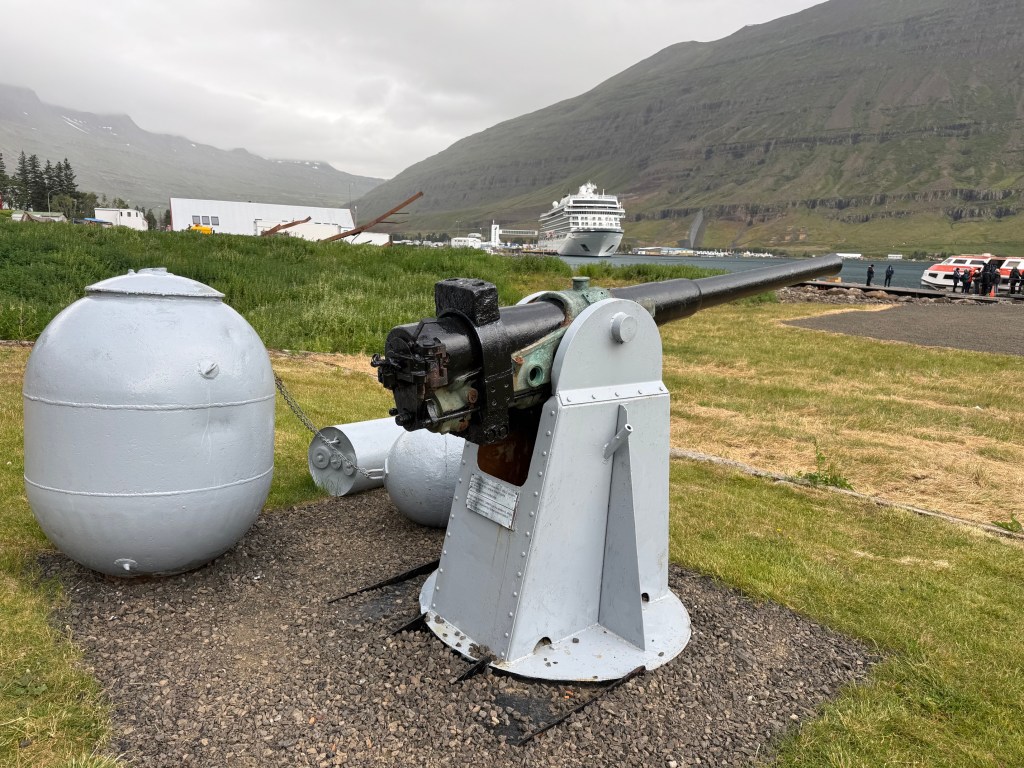
As we near the tender landing for our return to the ship, we pass a tableaux about the disastrous landslides that hit the town in 2020. Then, we encountered signage about the wreck of the El Grillo and one of its guns, now mounted on the shore.
One panel describes “The Big Landslide That Changed Everything.” On December 18, 2020, after an unprecedented five days of rain that nearly equaled Reykjavík’s average annual precipitation, a gigantic landslide swept through Seyðisfjörður. The slide destroyed 13 houses and damaged others, many dating from around 1900 and possessing significant cultural and historical value. The town museum suffered considerable losses, with much of its buildings destroyed, although some collections were salvaged. The sign notes that the damage to Icelandic cultural heritage was among the most significant ever experienced in the country. Although the landslide itself lasted only minutes, smaller slides had preceded it for days, the town’s infrastructure was overwhelmed, and emergency responders worked almost continuously. After the disaster, the entire town was evacuated for several days. Many residents lost their homes, businesses disappeared, some people could never return because of the continuing danger, and, as the exhibit poignantly concludes, “The sense of security for most inhabitants was profoundly shaken.”
Nearby stands a four-inch Garrett quick-firing naval gun, salvaged from the British tanker SS El Grillo. The plaque reads:
“A four inches GARRETT CANNON from the tankship EL GRILLO which was sunk (torpedoed) by German planes the 10th of February 1944. The ship is still there underseas.”
Additional signage explains that these quick-firing guns, each weighing about 610 kilograms (1,345 pounds), were originally manufactured for the British Royal Navy in the late nineteenth century and later modified for wartime service. During the war, three German aircraft attacked and heavily damaged El Grillo. The wreck still rests on the bottom of the fjord, and efforts to seal the wreck and pump out leaking oil have continued over the years.
Another panel offers a sobering reminder that the war touched the people of Seyðisfjörður as well:
“The war also brought danger. German aircraft frequently flew over the fjord, and air raid sirens were a regular occurrence. In the autumn of 1942, a bombing raid injured four young boys, and one of them lost his leg.”
It is difficult to imagine such a peaceful, picturesque harbor echoing with air-raid sirens and the sound of enemy aircraft overhead. Yet those reminders—together with the rainbows, waterfalls, colorful houses, and the welcoming smiles of today’s Seyðisfjörður—are what make this extraordinary little town so memorable.