THE FORGOTTEN BATTLE – ALEUTIAN ISLANDS, 1943
THE FORGOTTEN BATTLE · ALEUTIAN ISLANDS, 1943
MAY 11–30, 1943 · ATTU ISLAND, ALASKA
Snow in the Pacific
The Battle of Attu was the only World War II land fight on North American soil—and one of the bloodiest in the Pacific relative to the number of men engaged.
Most people who can name Midway or Iwo Jima have never heard of Attu. That is not an accident. The island sits at the far western end of the Aleutian chain, closer to Kamchatka than to Anchorage, wrapped in fog and williwaw winds. In May 1943, American and Japanese soldiers fought there for nineteen days in snow, mud, and near-constant storm. Veterans later called it the Forgotten Battle. It should not stay forgotten.

U.S. troops coming ashore at Massacre Bay, May 1943. The Japanese did not contest the beaches in strength.
Why Japan took American soil
On 7 June 1942—exactly six months after Pearl Harbor, and one day after they occupied nearby Kiska—Japanese troops landed unopposed on Attu. The islands were a northern flank for the Midway operation and a wager that a foothold in the Aleutians might threaten Alaska, worry the West Coast, or pull U.S. ships away from the Central Pacific.
There was almost no one to resist them. Attu’s only settlement was a small Unangax̂ (Aleut) village at Chichagof Harbor. Japanese forces captured the roughly forty remaining residents along with the island’s schoolteacher and radio operator and shipped them to internment on Hokkaido. Sixteen of the villagers died of disease and starvation. After the war they were not allowed to go home.
Washington judged the destroyed village too expensive to rebuild and relocated the survivors to Atka.
For nearly a year the occupation sat on the edge of American maps while the real war ran through Guadalcanal and New Guinea. That delay would cost both sides.
Operation Landcrab
Allied planners first thought of hitting Kiska, then chose Attu because it looked more weakly held. Early intelligence guessed a few hundred Japanese. By April 1943 the estimate was about 2,400. The 7th Infantry Division—trained in California for desert warfare—drew the assignment. Weather pushed D-Day from 7 May to 11 May.
About 12,500 to 15,000 U.S. troops landed, backed by naval gunfire and Canadian reconnaissance and fighter-bombers. Colonel Yasuyo Yamasaki commanded a Japanese garrison of roughly 2,500–2,600. He had already pulled his men off the beaches and into the high ground.
The landings came at two points: Massacre Bay on the south and Holtz Bay on the north. The Japanese did not fight for the sand. The fight began inland, in tundra and snow, on ridges that disappeared into fog.
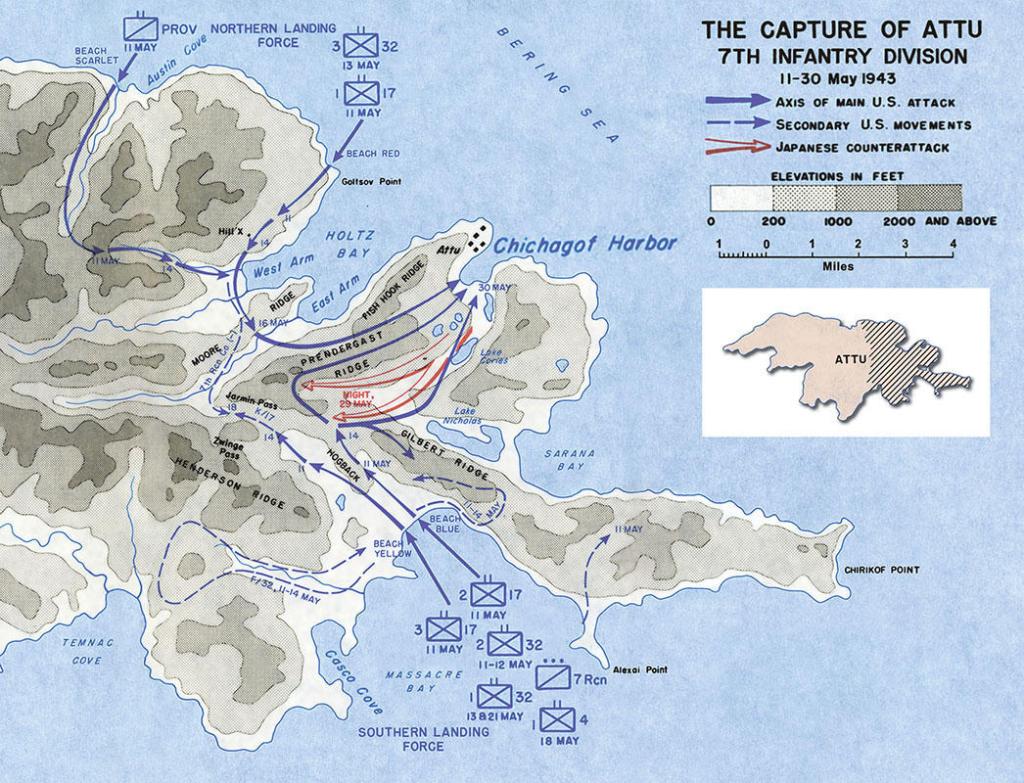
Map of the May 1943 recapture of Attu. Northern and southern landing forces closed on Chichagof Harbor.
The weather was the other army
Attu is the only place American and Japanese forces fought in Arctic conditions. Williwaws, freezing rain, and ground that never dried produced more U.S. casualties than Japanese fire. The winter clothing issued to the 7th Division was not enough. Men lived for weeks in wet boots. Trench foot, frostbite, and exposure put more than 2,100 soldiers out of action.
Supply planes often could not find units in the fog. Some companies went days without rations. Soldiers scavenged Japanese clothing and food when they overran a position—and risked being shot by their own side if they were seen in enemy uniforms. Both armies were scoured by winds that could exceed a hundred miles an hour.
Men who could not walk crawled, because stopping meant freezing.
American soldiers carrying a wounded man across Attu’s snowfields. Weather injured more U.S. troops than combat.
The last charge
By late May the surviving Japanese were squeezed into a pocket around Chichagof Harbor. On the night of 28–29 May, Yamasaki ordered that wounded men who could not walk be killed—including patients in the field hospitals—and led the remaining able-bodied troops, several hundred of them, in one of the largest banzai charges of the war.
They broke through the front line and reached rear-area support troops. Hours of hand-to-hand fighting followed. Yamasaki was killed. Almost all of his men died in the charge or by suicide, often with grenades held to the chest. Only 28 Japanese were taken prisoner. None were officers. Isolated holdouts kept fighting into July; a few lasted until September.
A Japanese medic, Dr. Paul Nebu Tatsuguchi—an American-trained Seventh-day Adventist physician—left a diary that has become the most intimate Japanese account of the battle. His last entries describe starvation, the killing of the wounded, and his own coming death. He was killed when U.S. troops overran the hospital on 29 May.

“The last assault is to be carried out. All the patients in the hospital are to commit suicide. Only 33 years of living and I am to die here…. Good-bye, Taeki, my beloved wife, who loved me to the last.”
— Dr. Paul Nebu Tatsuguchi, 28 May 1943
What it cost
Figures commonly cited by the National Park Service, drawing on historian John Haile Cloe:
Relative to the size of the garrison, Attu ranks just behind Iwo Jima among Pacific battles. For the Americans, weather casualties exceeded combat casualties. The Army redesigned cold-weather boots, clothing, tents, and rations after Attu—the first large combat-related exposure crisis of the war.
What followed
Japan announced the loss of Attu on 30 May.The garrison on Kiska was secretly evacuated by sea in late July under cover of fog. When a large Allied force, including Canadians, landed in August—Operation Cottage—the island was empty except for booby traps and dogs. Friendly fire in the fog still killed men on an island with no enemy left.
Attu never became the unsinkable aircraft carrier Japan hoped for. It did become a U.S. air base for raids toward the Kuriles. Lessons from the landing—joint Army-Navy work, amphibious technique, Japanese close-combat tactics—were applied later across the Pacific.
The battlefield and airfields were designated a National Historic Landmark in 1985. Attu is now part of the Alaska Maritime National Wildlife Refuge and has been uninhabited since the Coast Guard closed its LORAN station in 2010. Remains recovery has continued in fits and starts; limited excavations as recently as 2024 found additional Japanese dead.
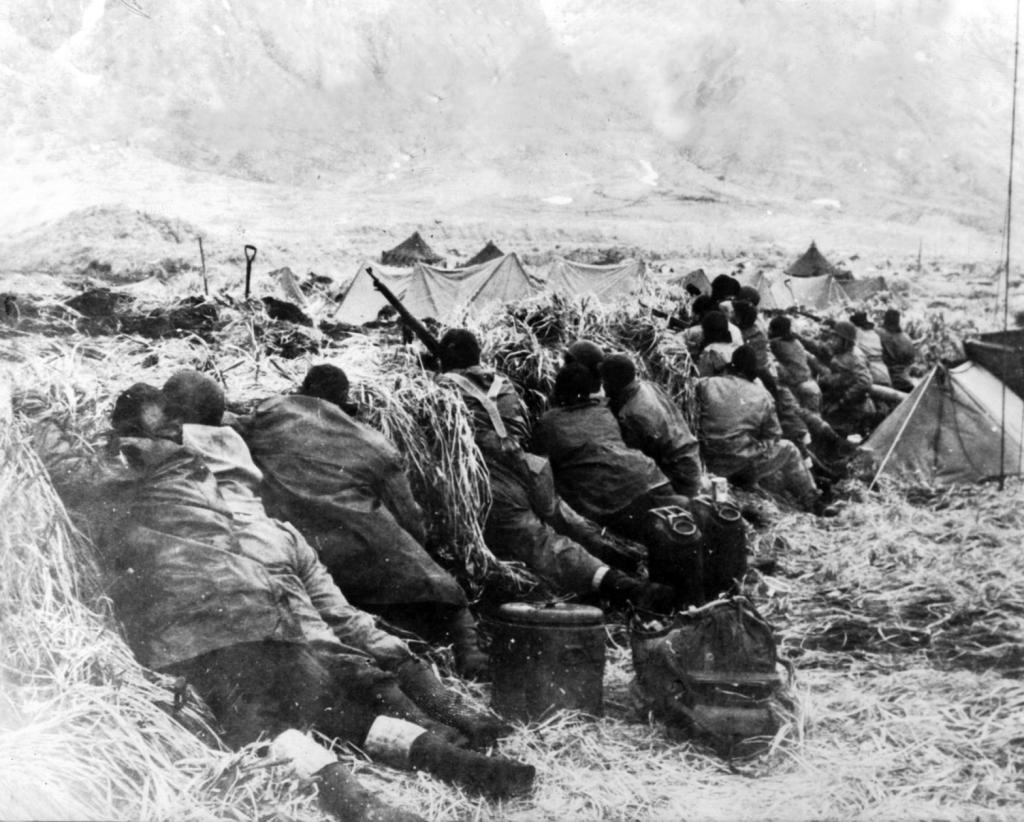
American troops in the tundra near their tents. Isolation, fog, and wet cold defined the campaign as much as enemy fire.
Why it still matters
Attu sits at an awkward intersection of American memory. It was the first time since 1812 that the United States had to retake its own soil from a foreign army. It was also a catastrophe for a Native community that never went home. The weather that wrecked the 7th Division’s feet is the same weather that still keeps most visitors off the island.
The fight did not decide the Pacific War. Midway and Guadalcanal did more. But Attu showed, earlier than most Americans realized, what island fighting against a Japanese garrison that would not surrender would cost—and it showed it in snow rather than jungle. The ratio of dead to the number of men engaged is the part that should stay in the record. So should the names of the Unangax̂ who were taken from Chichagof Harbor and never returned.
The island is quiet now. The craters are still in the tundra. That is the whole story, if anyone goes looking.
Notes
This essay draws on the U.S. National Park Service account of the Battle of Attu, John Haile Cloe’s Aleutian campaign research, the National Historic Landmark nomination for the Attu battlefield, and standard campaign summaries (History.com, Council on Foreign Relations, U.S. Army historical notes). Casualty figures follow Cloe as cited by NPS. Code name: Operation Landcrab. Commanders: Maj. Gen. Albert E. Brown and later Brig. Gen. Eugene M. Landrum (U.S.); Col. Yasuyo Yamasaki (Japan).
Battle of Attu · A history essay ·