Ahoy! Akureyri, Iceland
Ahoy! Akureyri, Iceland
— David Eugene Perry
Ahoy! We dock in Akureyri, Iceland’s second largest city. It’s a gorgeous, clear and pleasantly chilly day.
Our walk begins along the waterfront in Oddeyri, Akureyri’s second-oldest district. Today it feels quiet and orderly, but the historical signs tell a livelier story: merchants challenging Danish trading monopolies, bakers helping organize workers, buildings repeatedly surviving fires, and a shoreline gradually transformed into streets, homes and piers. The old photographs make it easy to imagine the neighborhood when boats landed almost at the front doors and much of the lower ground was still vulnerable to tides and flooding.
Signage along the way says:
Oddeyri District
Oddeyri is Akureyri’s second oldest district. The site was only used for parliamentary meetings from early 14th century until 1551 when two warships arrived to quell a rising led by the Roman Catholic bishop, Jón Arason, of Hólar, who had, however, been executed the year before. No battle ensued, but his possessions were confiscated and given to the king and his heirs.
In 1874 the 1000 year anniversary of the settlement of Iceland was celebrated on Oddeyri. Nothing was built there due to lack of drinking water and flooding risks from Glerá River. However, in 1866, the Danish authorities agreed to include Oddeyri in the township of Akureyri.
The first house, Lundur, was built in 1858. A similar house of the same name stands at Eiðsvallagata 14. After 1870 building began in earnest with the establishment of Gránufélag, Akureyri’s first commercial company.
Around 1900 Akureyri had 10 streets, 5 of which were on Oddeyri: Strandgata, Glerárgata, Lundargata, Norðurgata and Grundargata.
A second sign explains the commercial struggle that helped shape the district:
Fight against Monopoly
There was little incentive to build on Oddeyri — no work and far from the centre of Akureyri. No roads were built until around 1892, so communications were difficult in inclement weather. However, in 1869, the coming of the Icelandic commercial enterprise, Gránufélag, saw Oddeyri’s inclusion into Akureyri township. The company’s boat, Grána, transported goods to and from Iceland.
Two years later the company set up a store in the building Lundur, sparking fierce competition with Danish tradesmen who had held a monopoly over Akureyri’s commercial business. But Gránufélag did not require all their land and sold off small pieces to the townspeople. Some for pasture, others for house building.
By the shore were landing places for shark fishers, and later herring boats. Piers sprang up and, on higher ground, vessels were built. From the early 20th century and up to WWII refuse was disposed of below and to the north of Gránufélag’s premises. Ash and other waste was thrown into a very large tidal pool, long gone to make way for streets and houses.
The next sign turns from merchants to bakers and labor organizers:
Bakers & Union Builders
In 1900 only 10 street names were registered for the whole town, but in 1904, when Oddeyri street names were added, the overall number increased significantly. Hríseyjargata was on the map although it only had one building and much of the proposed road was under the tidal pool. Sea water is still a problem and pumps are needed in many cellars of Lower Oddeyri properties.
The crossroads at Hríseyjargata and Strandgata became “Baker’s Corner” when Strandgata 41 was built in 1901 specially to house a bakery. The baker, Olgeir Júlíusson, was one of the first to establish a workers’ union in Akureyri and his son, Einar Olgeirsson, born 1902, became a union leader and member of Parliament.
Strandgata 39, Karlshús, is well known for surviving in spite of going on fire six times. There was also a bakery in the four-storey building next door, Strandgata 37, the only house built according to the town plan of 1927.
Another nearby sign describes Oddeyri as a center of commerce, entertainment and wartime activity:
Hub of Activity
In 1900, Grundargata was a mere track. At its corner stood Hotel Oddeyri, seen to the left. On the founder’s death in 1898 his widow took over, expanding the business by 50%. The hotel was destroyed by fire in 1908 and she moved the business to Strandgata 1.
The site stood vacant until 1924, when a furniture maker constructed a new building, with a workshop behind it. Later, the workshop was taken over by the TV company Samver, which in 2003 became part of the town television network.
Below the crossroads, in Havsteenshús, Strandgata 35, lived Jakob V. Havsteen, known as “The King of Oddeyri,” who was a harpoon gunner and merchant. Here, behind the house, sheep were brought for slaughter.
In 1922 the first state liquor store in Akureyri was opened in the cellar. During WWII the house was let to British troops and was known as “The Norwegian House,” as it was mostly used as a leisure centre for Norwegian soldiers. Since the war, the building has been used as residential housing.
One tiny memorial stops us in our tracks. It reads, “Here rests BSO — Akureyri’s cultural mouse, 1956–2026.” Icelandic humor apparently extends even to gravestones for beloved local mascots.
We continue into the center of town and Ráðhústorg, the main square. This was once Akureyri’s great gathering place: the spot for shops, cinemas, buses, celebrations, political meetings and, naturally, the latest gossip.
The signage here says:
Main Square
You are standing in Ráðhústorg Square where the heart of the town beats. Although the town hall was not built here — its intended site was taken over by the National Bank — the square was always bustling with life and activity, being surrounded by financial institutions, shops, cinemas and taxi stations.
Here you bought papers, magazines and hot dogs from street vendors and filled your car with petrol. This is where mass meetings assembled and sports events were arranged. Here the terminal for the Reykjavík bus used to be, where people came to meet friends and relatives arriving from the capital — or pick up the latest gossip.
It was in Ráðhústorg that people rejoiced in the establishment of the Republic of Iceland, 17 June 1944 — still the date on which students from the local college celebrate their graduation by marching through the square.
Akureyri has a wonderfully playful streak. Brightly colored shoes hang from wires outside an old building, while a pointed red roof rises behind them. Farther downhill, the compact blue-and-white expedition ship Ocean Victory fills the end of the street. Its unusual inverted bow gives it the look of a vessel designed for serious water rather than cocktail-hour cruising. It carries fewer than 200 passengers and is equipped for expedition travel, including polar itineraries and Zodiac landings.
Then we climb.
At the top of Akureyri’s long staircase stands Akureyrarkirkja, the city’s great Lutheran church. Its tall, symmetrical towers and severe geometric façade look almost theatrical against the gray sky. From the hill, the view opens over the town and Eyjafjörður, with cruise ships resting below and long green mountainsides stretching beyond the water.
Those mountains look soft from a distance, almost as though green fabric has been draped over dark rock. The landscape was built by volcanic activity and then carved and widened by Ice Age glaciers. Fire made the land; ice sculpted it; moss, grass and streams softened the result.
Above town, a Progress Pride flag snaps in the wind. Nearby, another sign reveals an unexpected bit of Icelandic history.
Signage along the way says:
At the scene of the first television in Iceland
Between 1934 and 1936 remarkable experiments were conducted at Sjónarhæð, the house at the bottom of the hill before us. Two communication enthusiasts received television transmissions from the Crystal Palace Studios in London with equipment they had partially created themselves. The two men were an Englishman, Fredrik Livingstone Hogg, an engineer, and his apprentice, 22-year-old Grímur Sigurðsson, who later became a radio mechanic. At the time, few Icelanders had even heard about television and most were still absorbing the magic of radio that had only recently been introduced.
The transmissions received by these two men were the first in Iceland and made Grímur Sigurðsson the first Icelander ever to watch television. Both were experimenting during TV’s absolute infancy in the world. In order to do so they borrowed a few devices from the UK but others they built themselves. The antenna they needed to receive these broadcasts from London was already present in Akureyri, because a few years earlier the missionary Arthur Cook and his Christian Sjónarhæð Congregation had pioneered radio broadcasting in Iceland by setting up a missionary radio station at Sjónarhæð. Fredrik Livingstone Hogg had been the main technical person in that endeavour.
This radio station was one of the two first in Iceland operated before the creation of the state Broadcasting Service, RÚV. RÚV had the broadcasting monopoly from 1930–1986. Both of these stations were closed down before the state radio began operation.
At the beginning of the 1930s in London, some experiments were being done on TV transmissions over long distances. These experiments were part of an international competition to see which technology would win out in the television business. It was especially important to see which technology the BBC would choose for its broadcasts. The broadcasts that were received in Akureyri were based on “mechanical television technology,” pioneered by the Scottish inventor John L. Baird, who conducted experimental transmissions from Crystal Palace. This technology ultimately lost out in the competition and, after a major fire at Crystal Palace Studios in 1936, the broadcasts were ceased.
In a 1980 radio interview, Grímur Sigurðsson talked about the television project with Hogg. He said the technology they used had been 30-line technology, which means that the screen and the images they were viewing were small, probably similar to today’s cell phone screen. Transmissions were sent four nights a week for about an hour each, between 22:00 and 23:00. Grímur did not go into detail about what they were watching but said that sometimes the pictures were very clear. He particularly recalled watching a dancing woman who had a large ring on one of her fingers that they saw very clearly.
The canyon below is called Barðsgil. It is located above the Sjónarhæð House, and was important in the pioneering radio and television work in Iceland. The antenna towers that were built for radio were later used for television broadcasts and were about 35 metres high, located on each side on the top of the canyon. Connected to the antenna towers was an extensive web of copper wires that was buried in the ground and served as the ground connection. The copper is presumably still buried here under the trees and vegetation that has grown up in the canyon over the last eight decades.
The images were small and unreliable, but sometimes astonishingly clear—an early flicker of the future arriving in northern Iceland.
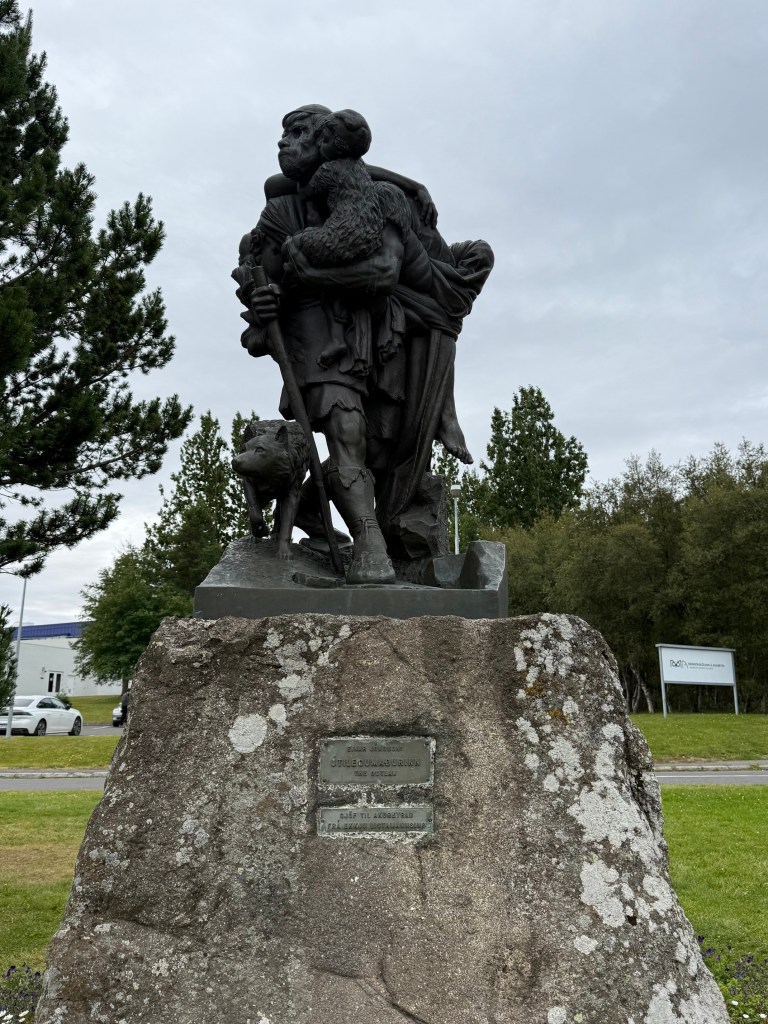
We pass the statue of “The Outlaw,” a rugged figure carrying a woman while a dog follows at his side, and then encounter one of Akureyri’s better student traditions. A path leading downhill from the junior college became known as the “Road to Destruction,” because students used it on their way to dances and nights out. Walk uphill, however, and it becomes the “Road to Education.” The town has managed to turn topography into a moral lesson.
The Akureyri Botanical Garden is a complete surprise. Just below the Arctic Circle, it is lush with trees, fountains and flowers from around the world. Himalayan blue poppies glow among pink blossoms, and the whole garden feels sheltered and extravagant, like a green secret hidden above the fjord. A memorial marks its founding in 1912.
Nearby stands the old junior-college building, constructed in 1904 in the decorative Swiss style. We also notice several beautifully maintained homes dated 1926 and 1928—substantial, almost mansion-like houses from a period when Akureyri was growing in confidence and prosperity.
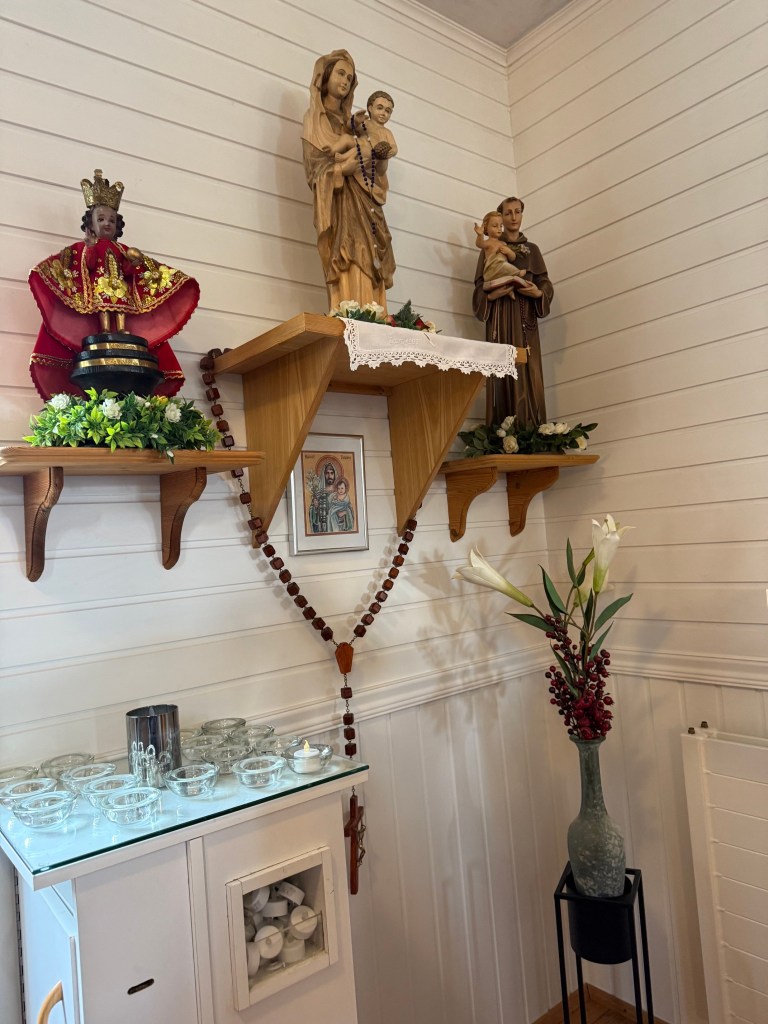
Our next stop is St. Peter’s Catholic Church, a modest white wooden building trimmed in red. Compared with the monumental Lutheran church, it feels intimate and domestic. Inside are statues of Mary, the Christ Child and Saint Anthony, votive candles and an enormous wooden rosary. Nuns are preparing for Mass; they appear to be Carmelite sisters rather than Benedictines. The building began life as a house and was acquired for Catholic use in the early 1950s.
Back near the water, we read about Barðsnef, once considered as a possible new town center, and pass Sigling, Jón Gunnar Árnason’s dramatic steel sculpture. Its sweeping shapes suggest a ship, bird, sail and movement all at once. Set against the fjord, it seems less like a fixed monument than something poised to take flight.
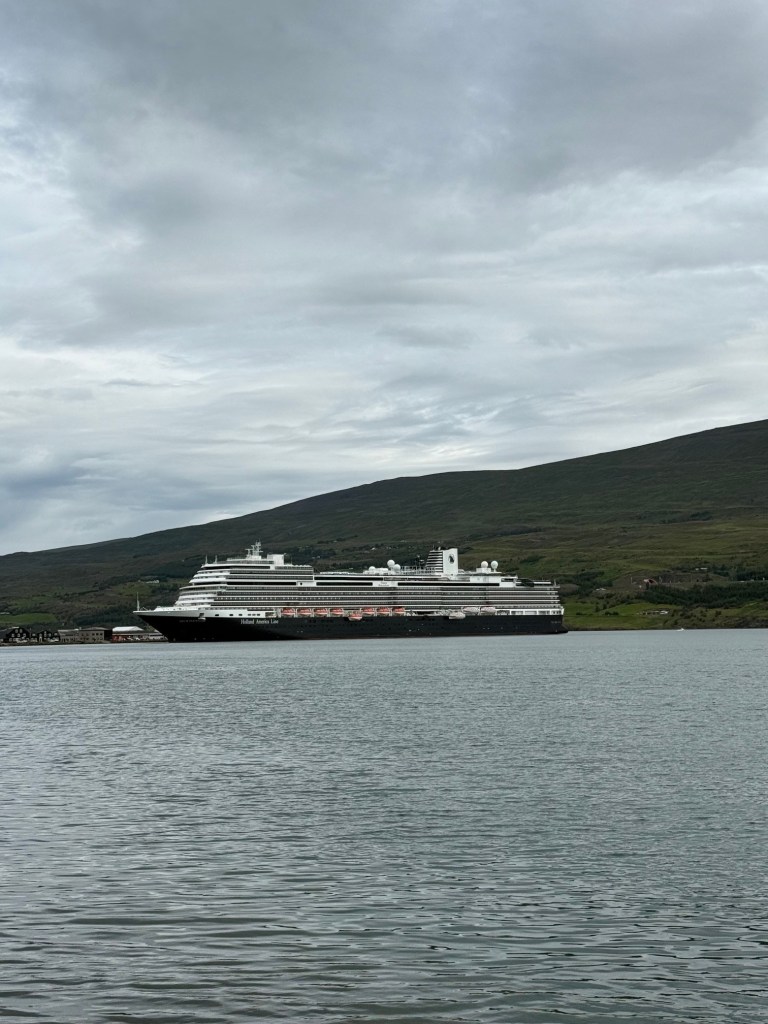
The harbor has grown busier by the time we return. Large cruise ships sit across the water, while Ocean Victory remains alongside the quay, compact and purposeful beside them. Akureyri’s mountains surround the scene like the walls of an enormous green amphitheater.
And after all that climbing, history, churches, ships and botany, we finish exactly as sensible travelers should: with a beer at Akureyri Backpackers.
Skál!