First Footsteps in Greenland: Exploring Historic Paamiut
First Footsteps in Greenland: Exploring Historic Paamiut
— David Eugene Perry
7 August 2026: Ahoy! Today we set foot in Greenland for the first time this trip: Paamiut, with a population of about 1300. It is a true Arctic village, first settled around 1500 B.C. Although Paamiut is home to only about 1,300 residents today, archaeology tells us people have lived in this region for more than 3,500 years.
A short distance from the tender landing in the center of town is a plaque bearing the words “PaamiutAsasara”—“My Beloved Paamiut.”
Written by Enok Poulsen in 1988, it expresses something every resident seems to understand instinctively: no matter how far one travels, thoughts eventually return home. Below is the translation
Even though I travel far from here,
and visit many other places,
my thoughts always return
to my homeland,
to my own people,
to my beloved Paamiut.
Though I may meet new friends,
and see beautiful lands,
nothing can replace
the place where I was raised,
the land that gave me life—
my beloved Paamiut.
The mountains,
the sea,
the islands,
all belong to my memories.
Paamiut, my beloved.
No matter where I journey,
no matter how long I stay away,
I will always long to return
to my homeland,
to my people,
to my beloved Paamiut.
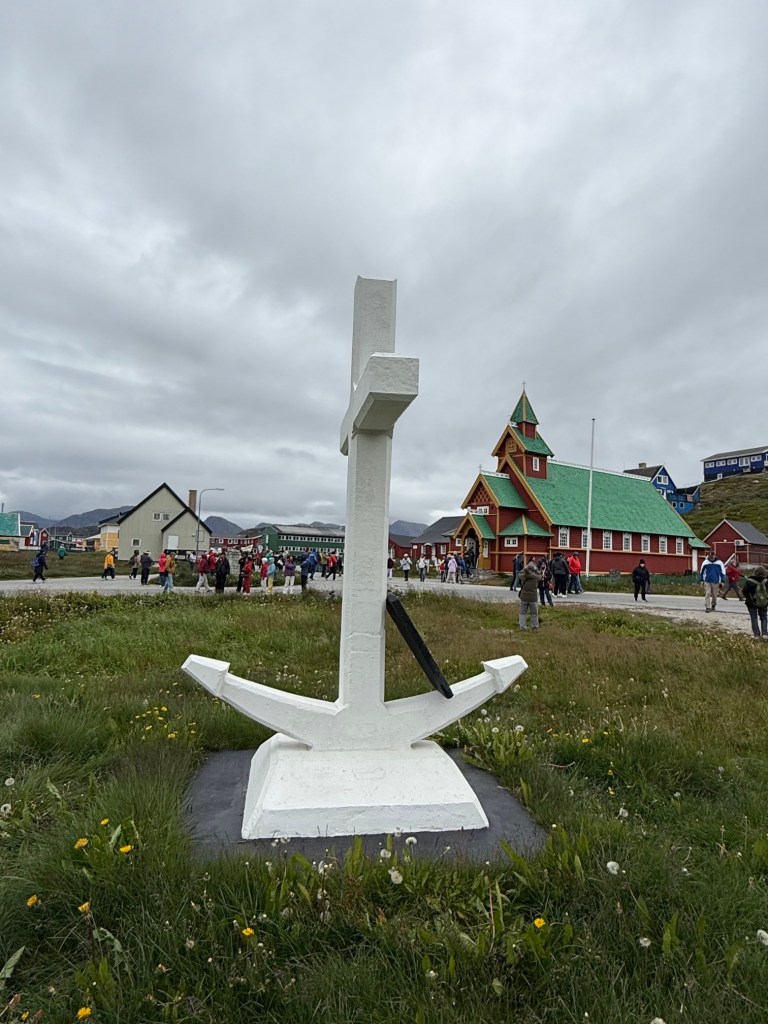
A short walk away is the Eqqissinerup Oqaluffia (Church of Peace), Paamiut’s historic Lutheran church. Designed in the style of a traditional Norwegian stave church, its distinctive red exterior and green roof have made it one of the town’s best-known landmarks for more than a century. Inside, the sanctuary is warm, intimate, and beautifully understated. Soft blue walls frame a white altar beneath an elegant vaulted ceiling.
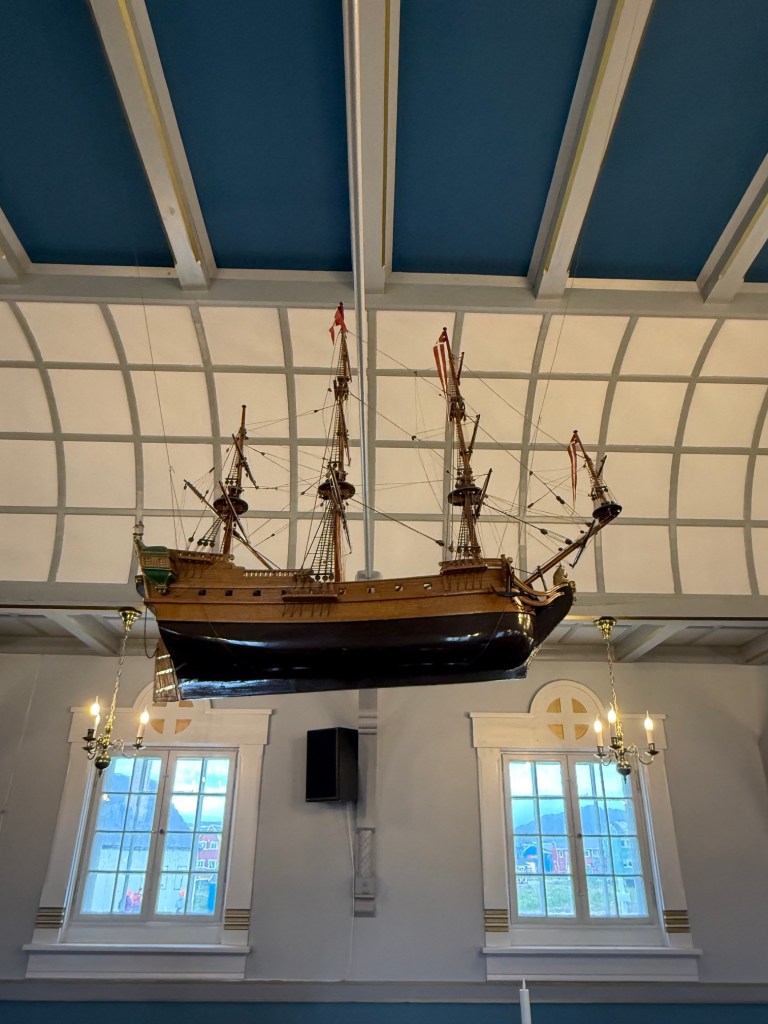
Suspended overhead is one of the church’s most distinctive features—a beautifully crafted sailing ship hanging from the ceiling. Model ships suspended in Scandinavian churches have long symbolized both thanksgiving and prayer. In fishing communities like Paamiut, where generations earned their living from the sea, the ship represents hope for safe voyages and remembrance for those who never returned.
Outside, the adjoining cemetery spreads gently across the hillside, its simple white crosses standing against the gray granite and green tundra. Bright artificial flowers decorate many graves, adding welcome color to an otherwise subdued landscape.
Among the memorials we encountered was one that particularly caught our attention: a monument to five local men:
• Elias P.P.A.E. Møller
• Adolf D.H.J. Hansen
• Søren A.K. Kleist
• Emanuel Steffensen
• Nikolaj J.J. Hansen
The inscription records the date:
23 September 1940
At first glance one might assume they were casualties of war. In fact, historical records tell a different—and perhaps even more poignant—story. During the Second World War, these five men departed aboard a small motor vessel from Sisimiut. The boat never returned. After severe storms swept Greenland’s southwest coast, it was concluded that the vessel had foundered with all hands.
Nearby stands another memorial honoring those lost at sea, reminding visitors that tragedy has long been woven into everyday life along Greenland’s rugged coastline. Before radar, GPS, and modern forecasting, fishermen ventured into some of the world’s most unforgiving waters in comparatively tiny vessels, relying largely on experience, instinct, and faith.
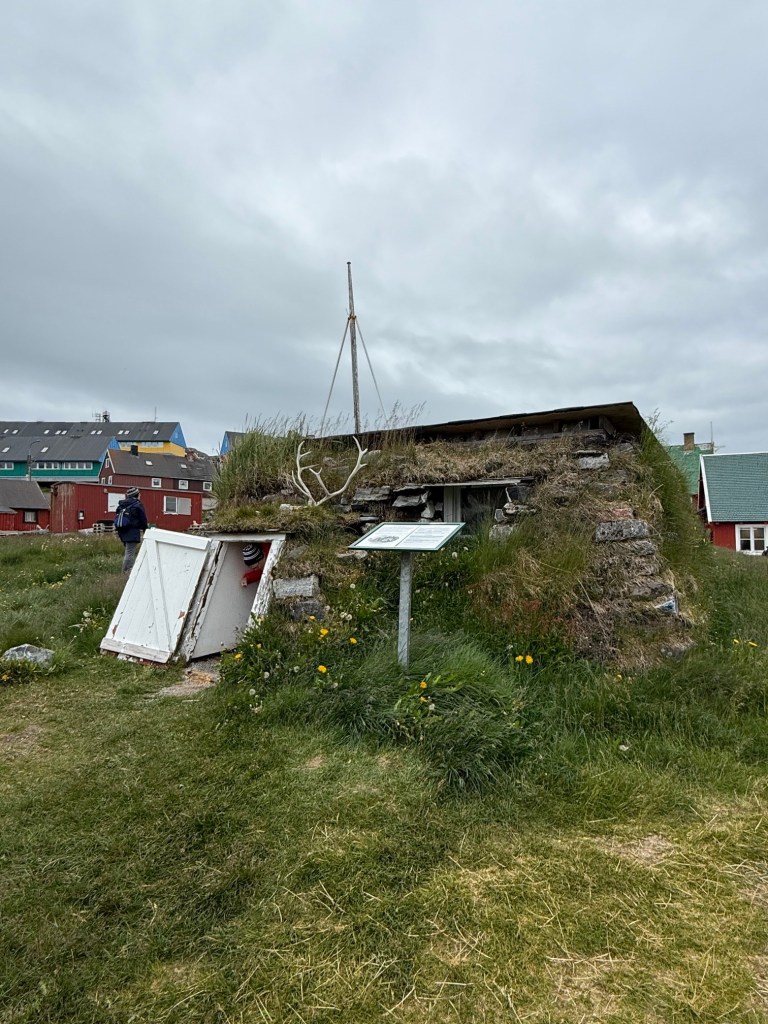
Just a short distance away sits one of Paamiut’s oldest surviving reminders of everyday life before modern housing: A traditional Greenlandic turf house. This kind of structure served as a family’s winter home for centuries. Built with stone walls packed with thick layers of turf, these ingenious dwellings provided excellent insulation against the Arctic cold. Driftwood, a precious commodity in treeless Greenland, formed the roof supports, while stretched seal intestine covered the window openings, allowing light inside while keeping out the wind. Heated by seal-oil lamps and the occupants’ own body heat, families slept together on raised platforms covered with animal skins. Larger houses sometimes sheltered several families under one roof. This reconstruction, completed in 1998 using original 1940s plans whenever possible, offers a fascinating glimpse into everyday life in Greenland before modern housing.
Next to the house, one of my favorite things: a ship, albeit now on land as a museum piece. The fishing vessel DINA as built at the Svendborg Shipyard in Denmark in 1948 and delivered to Paamiut the following year. Owned by local fishing pioneer Anthon Petersen, who named the vessel after his wife, Dina, it was the largest fishing vessel sent to Greenland that year and was used for pound-net and trawl fishing. After Petersen’s death in 1984, a memorial was erected in his honor opposite the museum. In 1992, DINA was donated to the Paamiut Museum, where it remains on display as a reminder of the town’s commercial fishing heritage.
After our initial walk about, we headed to the overlook above town. The climb was gradual until the very end, where an observation tower beckoned with spectacular views—and one final obstacle. To reach the platform required climbing through a trap door, an architectural feature that probably never bothers most visitors but instantly gets the attention of anyone like me who dislikes heights. I took a deep breath, climbed through. Beyond the harbor floated icebergs of every imaginable shape while, farther offshore, Nieuw Amsterdam rested quietly and frigidly at anchor. I gave Alfredo a quick wave from above, admired the magnificent panorama long enough to justify the effort, and then happily returned to solid ground.
Not everything we encountered celebrated the past.One particularly interesting sign introduced us to Pilersitsivik Paamiut, a vocational program investing in Greenland’s future by preparing young people for maritime careers.
Rather than emphasizing classroom learning alone, the program focuses upon practical skills, craftsmanship, outdoor experience, and maritime training. The accompanying photographs show young Greenlanders learning everything from workshop skills to hunting, fishing, navigation, equipment maintenance, camping, and teamwork.
It struck me that this was a fitting continuation of the town’s history. For countless years, survival here has depended upon practical knowledge passed from one generation to the next. Today that tradition continues in a different form. It’s a rugged place to eke out a living.
Greenland is an autonomous territory within the Kingdom of Denmark. Greenlanders are Danish citizens and carry Danish passports, while Greenland has its own parliament (Inatsisartut) and government responsible for most domestic affairs under an expanded system of self-rule adopted in 2009. Denmark retains responsibility for defense, foreign policy, and citizenship. Although Greenlanders are Danish—and therefore EU—citizens, Greenland itself is not part of the European Union, having withdrawn from the European Economic Community in 1985 following a referendum, primarily over fishing rights. Greenlandic (Kalaallisut) is the official language, and Danish is also widely spoken, a dual heritage reflected in many of the bilingual signs found throughout Paamiut.
During the Second World War, Paamiut remained a small fishing community rather than a military center, but the war still affected daily life. After Germany occupied Denmark in 1940, Greenland was administered locally while the United States established bases elsewhere on the island to protect North Atlantic shipping routes and support Allied operations. Paamiut’s residents continued to rely on fishing and coastal shipping, but wartime conditions made those already hazardous waters even more difficult.
Now, thumb-typing on my iphone as we wait for the tender back to the ship, we’re looking forward to a nourishing hot toddy and then tonight’s traditional Dutch / Indonesian “Rijstaffel” dinner— a Holland America classic.
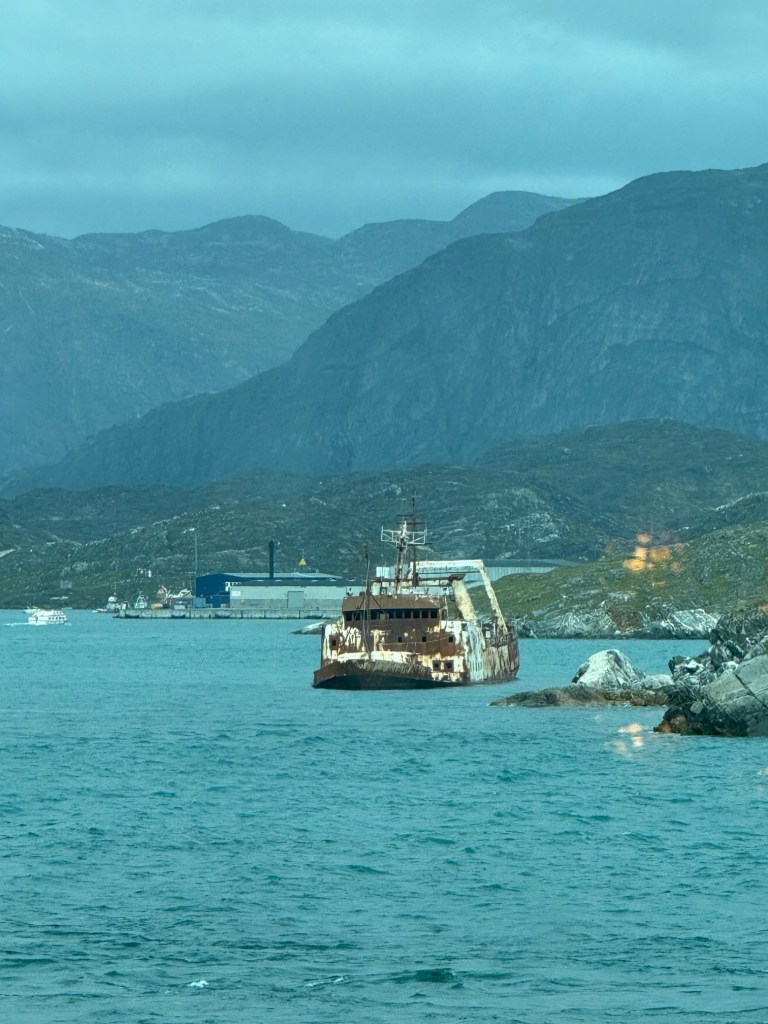
As our tender approaches Nieuw Amsterdam we pass the wreck of the Greenland Star. The 288-foot factory trawler was built in Bremerhaven, West Germany, in 1964 and originally sailed as Heidelberg. It ran aground at the entrance to Paamiut’s harbor on December 15, 1984, and it remains have rusted there ever since
A note about the colorful houses of Paamiut (and throughout Greenland): It’s not just an aesthetic choice.
Beginning during the Danish colonial era, building colors traditionally indicated their functions: red identified churches, schools, shops and the homes of teachers, ministers or traders; yellow marked hospitals and housing for doctors and nurses; green denoted power, mechanical or telecommunications facilities; blue was associated with fish factories and processing plants; and police stations were painted black. The system allowed residents to recognize important buildings at a glance before towns had formal street names and house numbers. Today the colors are used more freely, but they remain one of Greenland’s most distinctive architectural traditions.