Ahoy! As we all know, a ship is steered from “the bridge.” The term has become synonymous with authority and command. However, have you ever wondered why-when-and-how that term came into use? Take a read below!
The answer takes us back to the earliest days of steam-powered ships.
Traditional sailing ships were commanded and steered from the stern, where the ship’s wheel was located close to the rudder. But during the early 19th century, a revolutionary new type of vessel appeared: the paddle steamer.
These ships were propelled by enormous paddle wheels mounted on either side of the hull. The wheels were enclosed inside projecting structures known as “paddle boxes.” Shipbuilders soon constructed a raised walkway extending across the vessel from one paddle box to the other.
Because it physically connected—or “bridged”—the two sides of the ship, the walkway became known quite literally as the “bridge.”
The elevated position offered the captain a much better view forward, as well as a clear view over both sides of the vessel. This was particularly useful when navigating narrow channels, approaching docks or maneuvering inside crowded harbors. Standing forward of the funnel also helped the captain escape some of the smoke, sails and rigging that could obstruct visibility from the stern.
At first, however, the captain did not necessarily steer the ship from the bridge. The wheel often remained at the stern, close to the rudder and its complicated system of ropes, chains and pulleys. From his position on the bridge, the captain issued commands to the helmsman—sometimes by shouting, using a speaking trumpet or communicating through a voice pipe.
One particularly clear surviving example is a contemporary model of the Thames paddle steamer William, built in 1860 and now held by the National Maritime Museum in Greenwich. It shows the vessel’s two paddle boxes connected by a narrow raised walkway. The museum describes this as an early form of the bridge, from which the master gave orders to the helmsman stationed at the wheel in the stern.
Beginning in the 1840s, the more efficient screw propeller began replacing paddle wheels, especially aboard warships and large ocean-going vessels. Nevertheless, the raised command platform proved so useful that shipbuilders retained it—even after there were no longer paddle boxes for it to connect.
As steering technology improved, mechanical, steam-assisted and eventually hydraulic systems allowed the wheel itself to be moved forward. The captain, navigating officers and helmsman could finally be stationed together. The open platform gradually acquired a protected wheelhouse and was eventually incorporated into the ship’s superstructure.
There was no single moment when the original paddle-box bridge disappeared. The transition took place throughout the second half of the 19th century. By approximately 1900, the traditional walkway spanning two paddle boxes had largely vanished from newly built ocean-going ships, although similar open bridges continued aboard paddle ferries, riverboats and pleasure steamers.
The term, however, remained.
Today, the bridge is the sophisticated command-and-control center of a vessel. From there, the captain and officers oversee navigation, communications, propulsion, weather conditions and the ship’s safe operation. Modern bridges bear little physical resemblance to those exposed walkways perched above the paddle wheels—but their familiar name preserves that remarkable piece of maritime history.
One famous vessel associated with this transitional period was Isambard Kingdom Brunel’s extraordinary Great Eastern, launched in 1858. At approximately 692 feet long, she was the largest ship the world had yet seen. She possessed two enormous 56-foot paddle wheels—but she also had a screw propeller and auxiliary sails, employing all three principal forms of maritime propulsion then available.
The Great Eastern therefore represented both the culmination of the great paddle-steamer era and the technological future that would soon make ocean-going paddle wheels obsolete.
Today, paddle wheels survive primarily aboard historic vessels, excursion boats and faithful replicas. But every time a captain steps onto the bridge of a modern ship—including the bridge aboard our own Holland America Line vessel—we are using a term born aboard those pioneering paddle steamers nearly two centuries ago.
Ahoy—and now you know! Below is an especially good article from the U.S Naval Institute Magazine about the evolution of steering a ship at sea
Stavanger: Where Norway’s Maritime Past Meets Hollywood
— David Eugene Perry
Ahoy! Today, Holland America Line’s Nieuw Statendam docked at Sandnes, from whence we decamped to the historic and hugely important port of Stavanger. Once dominated by the oil industry, Stavanger is now a bustling tourism hub while remaining firmly rooted in its extraordinary maritime heritage.
Naturally, our first stop was the Norwegian Maritime Museum, celebrating its 100th anniversary this year. Beautifully curated, it tells the story of a city whose fortunes have always been tied to the sea—from herring fishing and shipbuilding to merchant shipping, tankers, offshore oil, and today’s thriving cruise industry.
Few cities have adapted as successfully as Stavanger. Beginning in the 1600s as a modest fishing port, it grew rapidly during the great herring boom of the 19th century. Local shipowners expanded from coastal sailing vessels to steamships and eventually to fleets trading around the globe. During the 20th century, Stavanger became one of Norway’s premier shipping centers, and when North Sea oil was discovered in the late 1960s, it transformed itself yet again into Norway’s energy capital. Today, tourism has become another major pillar of the local economy, but the city’s maritime DNA remains unmistakable.
The museum also traces the remarkable evolution of Stavanger’s shipping companies. They embraced every technological revolution—from sail to steam, from steam to diesel, and later from carrying passengers and cargo to transporting oil and gas. One exhibit recounts the story of Monsen Shipping, founded in 1812, one of the city’s oldest shipping firms, whose history mirrors Stavanger’s own transformation from regional trading port to international maritime powerhouse.
Waiting just outside in the harbor are two living reminders of that heritage.
The Rogaland, built here in Stavanger in 1929, spent decades carrying passengers and cargo along Norway’s coast between Stavanger, Bergen, and Oslo. Her history is extraordinary. During World War II she survived mines, groundings, and one of Norway’s worst wartime disasters. On April 20, 1944—Hitler’s 55th birthday—she was moored in Bergen harbor when the Dutch ammunition ship Voorbode, requisitioned by the Germans and carrying 120 tons of explosives, exploded nearby. The blast killed more than 100 civilians, devastated much of the harbor, and badly damaged the Rogaland, which eventually settled to the bottom. After the war she was salvaged, repaired, converted from steam to diesel in 1950, and returned to service. Retired in the 1960s, she was rescued by volunteers in 1989 and painstakingly restored. Today she once again sails as Stavanger’s official heritage ship.
Film buffs may recognize her as well. The Rogaland portrayed a white-painted hospital ship in Christopher Nolan’s Dunkirk, filmed in France in 2016.
Moored just ahead lies the Sandnes, launched in 1950. Unlike the Rogaland, she remains an authentic oil-fired propeller steamship, one of the last of her kind. For decades she worked the overnight coastal route linking Sandnes, Stavanger, Haugesund, and Bergen before being retired and preserved as a floating museum. Walking aboard is like stepping back into the twilight years of Norway’s steam age.
Stavanger’s influence on maritime history extends far beyond its own harbor. The city—and Norway’s west coast generally—helped shape the modern cruise industry itself. Norwegian shipowners, including Knut Kloster, pioneered today’s vacation cruising through Norwegian Caribbean Line, while his early business partner Ted Arison later founded Carnival Cruise Line. Meanwhile, Norwegian shipping companies also created Royal Caribbean, helping transform Miami into the cruise capital of the world.
And there is one more cinematic connection nearby. Less than an hour north, in Kopervik on the island of Karmøy, lies the modern Viking longship Draken Harald Hårfagre. Fully seaworthy and built using traditional Viking techniques, she portrayed Odysseus’ ship in Christopher Nolan’s new epic The Odyssey, proving that Norway’s maritime traditions are not merely preserved—they are still sailing into history. A personal note: Alfredo and I saw The Odyssey in Rotterdam before embarking this cruise and loved it. The at-sea scenes with that Viking ship are enough to make you reach for the Dramamine.
Stavanger may be known today for oil, but after a day exploring its museum, walking its waterfront, and stepping aboard these beautifully preserved ships, it is clear that the sea has always been—and remains—the heart of this remarkable city.
Ahoy! A Royal Encounter in Kristiansand: HNoMY Norge
David Eugene Perry
2y July 2026: Ahoy! Our first port of call today aboard Holland America’s Nieuw Statendam was charming Kristiansand, Norway. As we sailed into the harbor, my “ship spotter” eagle eye spied a gorgeous, and clearly classically designed, white yacht. To my delight, it turned out to be the Royal Yacht of the Norwegian Royal Family. Better yet—they were onboard, the Royal Standardflying proudly from the mainmast.
Naturally, I grabbed my camera and Alfredo and I made our way over to where she was berthed alongside Kristiansand’s striking Kunstsilo Museum, home to the world’s largest collection of Nordic Modernist art. So, below: a little history of this splendid vessel—HNoMY Norge. *
At first glance, Norge looks every inch the purpose-built royal yacht. In reality, however, she has had a remarkable second life. She was originally launched in 1937 by the celebrated British shipbuilders Camper & Nicholsons as the luxury yacht Philante, commissioned by aviation pioneer and yachtsman Sir Thomas Sopwith. During the Second World War, she was requisitioned by the Royal Navy and served as an auxiliary patrol vessel in the North Atlantic.
Following the war, an extraordinary chapter began. Rather than purchasing a yacht through government funds, the people of Norway decided to give one to their king. In anticipation of King Haakon VII’s 75th birthday, Norwegian newspapers organized a nationwide fundraising campaign. Schoolchildren contributed coins, families donated what they could, businesses added their support, and together hundreds of thousands of Norwegians raised approximately 1.5 million Norwegian kroner—enough to purchase and refit Philante.
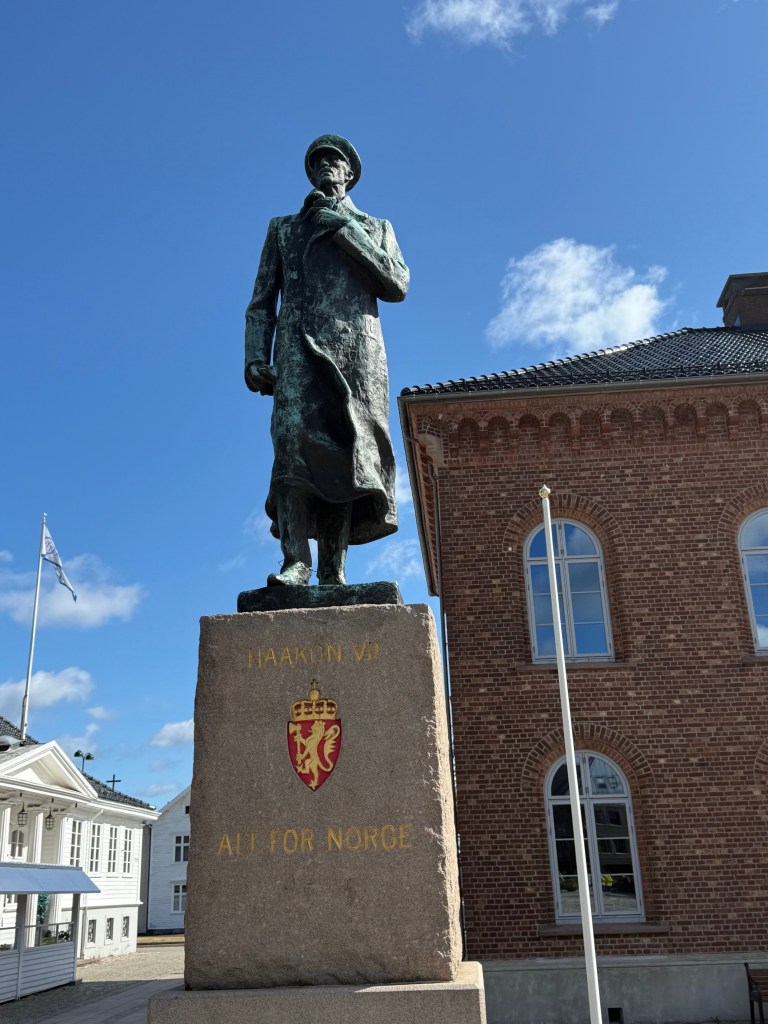
In 1947, she was presented to the King and renamed HNoMY Norge (“His Norwegian Majesty’s Yacht Norway“). It was far more than an elegant birthday gift. It was a heartfelt national thank-you. To understand why, one must understand King Haakon VII. Although born a Danish prince, Haakon became Norway’s king in 1905 after the peaceful dissolution of the union between Norway and Sweden. Over the following decades he earned the deep respect and affection of the Norwegian people through his modesty, accessibility, and unwavering devotion to constitutional government. His greatest test came on April 9, 1940, when Nazi Germany invaded Norway.
As dramatized so effectively in the superb film The King’s Choice, German authorities demanded that Haakon appoint the collaborationist politician Vidkun Quisling as prime minister and effectively legitimize the occupation. Haakon refused. He told his government that if they chose to accept Germany’s demands, he would rather abdicate than place his signature on such a decision.
Forced to flee northward before eventually escaping to Britain, Haakon spent the remainder of the war in exile in London alongside the Norwegian government. Throughout the occupation he became the living symbol of Norwegian resistance, speaking regularly by radio to his countrymen and reminding them that their legitimate government—and their freedom—still endured. When peace finally returned in 1945, King Haakon’s homecoming was one of the defining moments of modern Norwegian history. Crowds packed the streets of Oslo to welcome the man who had become, in many ways, the embodiment of Norway itself.
The gift of Norge two years later was therefore much more than the presentation of a beautiful yacht. It was the gratitude of an entire nation made tangible.
King Haakon VII died on September 21, 1957, at the age of 85. He is buried beside his beloved wife, Queen Maud, in the Royal Mausoleum at Akershus Fortress in Oslo. He was succeeded by his son, King Olav V, himself one of Norway’s most beloved monarchs, remembered affectionately as “The People’s King.” Upon Olav’s death in 1991, the throne passed to his son, King Harald V, who continues to reign today alongside Queen Sonja. Which made today’s encounter all the more special.
The very yacht that grateful Norwegians presented to King Haakon nearly eighty years ago was sitting quietly in Kristiansand Harbor with the present-day royal family aboard. The same polished white hull. The same graceful lines. The same Royal Standard fluttering above the deck. In an age when so much seems temporary, Norge remains a floating symbol of continuity—a working royal residence maintained not as an extravagant display of wealth, but as a living link between Norway’s constitutional monarchy, its naval traditions, and the remarkable king who helped guide the nation through its darkest hour.
For a maritime historian, spotting Norge was an unexpected highlight of the day. And for anyone who has seen The King’s Choice, seeing the yacht in person makes that remarkable story feel just a little more real. Ahoy!
* HNoMY is the Norwegian abbreviation for “His / Her Norwegian Majesty’s Yacht”. Norge is “Norway” in Norwegian
25 Hours on Titanic and a Lifetime of Photos: Father Browne
– David Eugene Perry
Ahoy! Having started my fascination with the late, great RMS Titanic when I was five years old, I have seen pretty much every photo ever taken of Titanic. For all the obvious reasons, there aren’t many. Her older, luckier sister ship, Olympic, however, was widely photographed during her long and successful career. Often books, blogs and now AI will substitute Olympic for Titanic. It’s something that drives maritime historians like me to distraction.
Of all the photos taken of Titanic, the most famous are those taken by a young Jesuit seminarian who has come down to history as “Father Browne.” Taken during 25 hours aboard Titanic, these photos are an irreplaceable and iconic window into history. Below, read about the man who took them, his subsequent career, the serendipitous connection to Titanic’s discovery and how filmmaker James Cameron recreated some of these photographs in his famous 1997 film.
Francis Patrick Mary “Frank” Browne was born in Cork, Ireland, on January 3, 1880, the youngest of eight children of James Browne and Brigid Hegarty Browne. His mother died from complications of childbirth only days after his birth. His father died in a swimming accident when Francis was nine.
Much of Browne’s education and financial support was subsequently overseen by his uncle, Robert Browne, the Roman Catholic Bishop of Cloyne. In 1897, when Francis was 17, his uncle gave him a camera to take on a tour of continental Europe. Photography became a lifelong pursuit.
After returning to Ireland, Browne entered the Society of Jesus. He attended the Royal University in Dublin, where one of his contemporaries was James Joyce. Joyce later made a passing reference to “Mr Browne the Jesuit” in Finnegans Wake. In 1909, Browne accompanied his uncle to Rome and received permission to photograph Pope Pius X during a private audience.
By 1912, Browne was studying theology at Milltown Park in Dublin. As a present, Bishop Browne purchased him a first-class ticket for the opening portion of Titanic’s maiden voyage: from Southampton to Queenstown, Ireland, by way of Cherbourg, France.
His ticket did not include the Atlantic crossing to New York. It was an overnight voyage aboard the newest and largest liner in the world, followed by Browne’s scheduled return to his religious studies in Dublin.
Twenty-five hours aboard Titanic:
Browne boarded Titanic at Southampton on April 10, 1912. He was assigned first-class cabin A-37 on the Promenade Deck and remained aboard for approximately 25 hours. Although he is now universally known as Father Browne, he was not yet a priest when he travelled on Titanic. He was a 32-year-old Jesuit seminarian and would not be ordained until 1915. During his brief time aboard, Browne explored the ship with his camera. He photographed the public rooms, decks, passengers and crew, recording ordinary life during the first hours of the ship’s maiden voyage.
His photographs included:
Captain Edward J. Smith standing on deck
Officers and crew members at work
The Marconi wireless room
The first-class dining saloon
The first-class gymnasium
Gymnasium instructor Thomas McCawley
Browne’s own first-class cabin
Passengers walking along the promenade
People boarding and leaving by tender
Third-class passengers and children
Deck machinery, lifeboats and structural details
Titanic anchored off Queenstown
Some of the final views of the ship as she departed Ireland
Several of the people captured by Browne were making their last recorded appearance. Captain Smith, McCawley, engineer William Parr, presidential aide Major Archibald Butt and novelist Jacques Futrelle were among those who would die in the sinking.
Browne’s pictures record more than the ship’s architecture. They show passengers reading, talking and walking; children playing; crew members attending to their duties; and stewards preparing the ship’s public rooms. They provide a record of Titanic as a functioning passenger liner rather than simply as a ship associated with disaster.
The unidentified American couple:
During the voyage, Browne shared a table in the first-class dining saloon with a wealthy American couple, often described in later accounts as millionaires. They apparently enjoyed the young Jesuit’s company and invited him to continue to New York with them. They offered to pay the cost of extending his first-class passage across the Atlantic. Some accounts state that they also offered to pay his return fare to Ireland.
Browne could not accept without authorization. As a Jesuit seminarian, he was subject to the authority of his religious superior and could not simply extend his travels or take an unplanned holiday. He therefore used Titanic’s Marconi wireless service to send a message to his provincial superior in Dublin requesting permission to remain aboard. The reply awaiting him at Queenstown was brief:
GET OFF THAT SHIP — PROVINCIAL
The identities of the couple have never been established. Browne did not name them in the surviving accounts, and no reliable passenger research has connected him definitively with a particular husband and wife. The Astors and other prominent first-class couples have occasionally been suggested, but there is no documentary evidence supporting those identifications. Consequently, it is not known whether the couple who made the offer survived the sinking.
There is also no evidence that Browne’s provincial had a premonition about the ship. Telegraph messages were charged by the word, and the instruction was consistent with the Jesuit system of obedience. Browne had permission to travel to Queenstown, not to New York. He obeyed the order.
Titanic’s final departure:
Browne left Titanic at Queenstown—now Cobh—on April 11. As the liner stood offshore, tenders carried passengers and mail between the port and the ship. Browne took additional photographs during the transfer and recorded some of the final images of Titanic above water. The liner then sailed west with approximately 2,200 passengers and crew aboard. Late on April 14, Titanic struck an iceberg. She sank during the early hours of April 15 with the loss of more than 1,490 lives.
When Browne learned what had happened, he understood the importance of the photographs he had brought ashore. His pictures were distributed to newspapers and photographic agencies and appeared in publications around the world. Browne reportedly retained the provincial’s telegram in his wallet for the rest of his life. He later referred to the incident as an occasion when religious obedience had saved his life.
Douglas Spedden and the spinning top:
One of Browne’s best-known Titanic photographs shows six-year-old Robert Douglas Spedden playing with a spinning top on the first-class promenade while his father, Frederic Spedden, and other adults watch. Douglas and his parents, Frederic and Daisy Spedden, survived the sinking. Afterward, Daisy wrote and illustrated a story for her son called Polar the Titanic Bear, recounting the family’s voyage and survival from the perspective of Douglas’s toy bear. Douglas survived Titanic but died three years later, in 1915, after being struck by an automobile.
James Cameron directly recreated Browne’s photograph in his 1997 film Titanic. When Jack Dawson enters the first-class promenade in search of Rose, he passes a small boy playing with a spinning top as his father watches. While the adults are distracted, Jack takes a coat belonging to one of the men. Titanic historian Don Lynch, who served as a consultant on the film, appears in the scene as Frederic Spedden. The composition reproduces the moment recorded by Browne in April 1912.
Cameron’s production team also used Browne’s other photographs as visual references for the construction of the ship’s sets, the placement of equipment, the appearance of the decks and public rooms, and the ordinary activities of passengers and crew. Browne’s photographs of the gymnasium, dining saloon, promenade, wireless room and deck areas helped provide evidence of how the completed ship looked during its only voyage.
Ordination and the First World War:
Browne returned to his religious studies and was ordained a priest on July 31, 1915, by his uncle, Bishop Robert Browne. In 1916, he joined the British Army as a Catholic military chaplain. He served principally with the Irish Guards on the Western Front and remained with the Guards until after the end of the war.
His service took him to the Somme and to Locre, Wytschaete, Messines Ridge, Passchendaele, Ypres, Amiens and Arras. As a chaplain, he moved among wounded and dying soldiers, administered the sacraments, assisted medical personnel, buried the dead and wrote to soldiers’ families. He was wounded on five occasions and was seriously affected by poison gas.
Browne received the Military Cross in 1917 for distinguished service in the field. In 1918, he received a bar to the Military Cross, signifying a second award. The citation recognized his repeated efforts to assist the wounded during an attack under heavy shellfire. France also awarded him the Croix de Guerre.
During his military service, Browne was permitted to carry a camera, a relatively unusual privilege in the British Army near active military positions. He photographed his fellow soldiers, trenches, ruined towns, religious services, periods of rest and the conditions in which the men lived.
His war photographs were primarily a private record rather than work intended for immediate newspaper publication. They show military life from the viewpoint of a chaplain serving among the soldiers.
“The Watch on the Rhine”:
One of Browne’s best-known military photographs is titled “The Watch on the Rhine.”
He took it in Cologne in 1919, after the fighting had ended, while Allied troops occupied parts of Germany. The photograph shows a British soldier of the Irish Guards standing watch beside the Rhine.
The title refers to Die Wacht am Rhein—“The Watch on the Rhine”—a famous 19th-century German patriotic poem and song calling upon Germans to defend the Rhine against foreign invasion. In Browne’s 1919 photograph, an Allied soldier is standing guard beside the river following Germany’s defeat.
Browne assembled a private album of his First World War photographs and named it after “The Watch on the Rhine.” Copies were presented to colleagues from the Irish Guards.
A gelatin-silver print of the photograph, dated 1919, is now held by the Raclin Murphy Museum of Art at the University of Notre Dame.
Ministry and photography after the war
After the war, Browne returned to Ireland and resumed his Jesuit ministry. In 1922, he was appointed superior of the Jesuit community attached to Saint Francis Xavier Church on Gardiner Street in Dublin.
The wounds and gas exposure he suffered during the war continued to affect his health. In 1924, his superiors sent him to Australia in the hope that travel and a warmer climate would assist his recovery.
Browne took his camera with him.
During the outward voyage, he photographed life aboard ship and made photographs during a stop in South Africa. In Australia he travelled approximately 3,000 miles, documenting cities, farms, cattle stations, industries, immigrant communities, Catholic institutions and the Australian outback.
On the return journey, he photographed Ceylon—now Sri Lanka—Aden, Suez, Salonika, Naples, Toulon, Gibraltar, Algeciras and Lisbon.
After returning to Ireland, Browne resumed his work at Saint Francis Xavier Church. In 1929, he joined the Irish Jesuits’ retreats and missions staff. For the next three decades, he travelled throughout Ireland preaching parish missions and conducting spiritual retreats.
Because many of his religious duties took place in the evenings and on weekends, he frequently used the daylight hours to explore the towns and countryside with his camera.
He photographed Dublin streets and tenements, farmers, fishermen, railway workers, schoolchildren, religious ceremonies, pilgrimages, rural customs, trains, buses, ships and early aircraft. His photographs recorded Ireland’s transition through the first half of the 20th century.
His work followed changes in transportation across more than six decades. His early photographs showed schooners entering Cobh Harbour. Toward the end of his life, he photographed transatlantic aircraft at Shannon Airport.
Browne also gave illustrated lectures, including presentations about his brief voyage aboard Titanic.
Death and burial:
Father Browne died in Dublin on July 7, 1960, at the age of 80. He was buried in the Jesuit plot at Glasnevin Cemetery.
By the time of his death, he had taken an estimated 42,000 photographs. His subjects included Titanic, the First World War, Ireland before and after independence, maritime travel, railways, early aviation, Australia, religious life and everyday working people.
Although his Titanic photographs remained known, the full extent of his photographic archive was not.
A trunk discovered in 1985
Twenty-five years after Browne’s death, Father Edward E. O’Donnell, S.J., discovered a metal trunk containing Browne’s negatives in the Irish Jesuit archives. Written on the trunk were the words “Father Browne’s Photos.”
Inside were approximately 42,000 negatives representing more than sixty years of photography.
The trunk was found in 1985—the same year that Robert Ballard and Jean-Louis Michel located the wreck of Titanic on the floor of the North Atlantic. Ballard’s expedition found the ship in September 1985, more than two miles beneath the surface.
The two discoveries returned attention to Titanic and to the Jesuit seminarian who had photographed the ship during the first 25 hours of her maiden voyage.
Father O’Donnell began organizing, researching and publishing Browne’s work. The negatives were preserved, printed and catalogued, and Browne came to be recognized as an important documentary photographer of early-20th-century Ireland.
The Titanic photographs were collected in Father Browne’s Titanic Album: A Passenger’s Photographs and Personal Memoir, edited by Father E. E. O’Donnell. A centenary edition was published for the 100th anniversary of the sinking.
O’Donnell also wrote a full biography, The Life and Lens of Father Browne, published by Messenger Publications. Other volumes have presented Browne’s photographs of the First World War, Dublin, railways, aviation, Australia and individual Irish counties.
A later collection, Travelling on Titanic with Father Browne, brought together his photographs and account of the voyage, with a foreword by Robert Ballard.
Father Browne spent only about 25 hours aboard Titanic. During that time, he recorded the ship’s officers, crew, passengers, interiors and decks. His religious superior’s order removed him—and his negatives—before the Atlantic crossing.
Decades later, those photographs provided historians and filmmakers with evidence of the completed ship during its maiden voyage. They also supplied James Cameron with specific human moments to reproduce onscreen, including a six-year-old boy playing with a spinning top while his father watched from the promenade.
The man remembered as “Father Browne of the Titanic” subsequently documented a world war, the Allied occupation of Germany, Australia, changing Irish life, ships, railways and the beginning of transatlantic aviation. The extent of that work became known only after the opening of a forgotten trunk in 1985.
The lights shine once again in the Titanic Memorial Lighthouse, and the time-ball drops at noon.
Unique among lighthouses of the era, the Titanic Lighthouse’s signature lantern was a fixed green light, not yellow or white—one of the few lighthouses in the country to use that color. The beacon consisted of three Cooper Hewitt mercury lamps, rated at 2500 cp each. Though the light was more symbolic than navigational, it could be seen six miles down The Narrows at the very entrance to New York Harbor. Under optimum conditions, it could be spotted up to 10 miles at sea, helping guide ships into port.
During its years of operation it was one of only two official Coast Guard lights on Manhattan Island, the other being the Jeffrey’s Hook Light beneath the George Washington Bridge, better known as “The Little Red Lighthouse.” Over the years the Titanic Light’s steady green light gleamed nightly as a welcoming beacon to all who knew it. During World War II, however, the light was extinguished “for the duration,” as were most other beacons around the world. However, the time ball continued its daily plunge at the stroke of noon. The Titanic Memorial Lighthouse originally stood on the roof of the 13-storey Seamen’s Church Institute at 25 South Street in lower Manhattan. Every year on April 15, memorial services were held at the Institute to commemorate the Titanic disaster.
The lighthouse stood atop the Seamen’s Church Institute building, shining its green light and dropping its noontime ball for decades. Then, on July 24, 1968, the Institute relocated to its new site at 15 State Street, and the old building was slated for demolition. The lighthouse and time ball were lowered intact to street level, where it wasdismantled by the Kaiser-Nelson Steel & Salvage Corporation. It was then gifted by the Institute to the South Street Seaport Museum, located several blocks up the East River. For many years Titanic Light’s time ball was the only surviving active instrument of its kind in the United States.
Learn more about the lighthouse and the South Street Seaport Museum at the link below: