Tokyo, Godzilla, Kyoto & Temples
Tokyo, Godzilla, Kyoto & Temples
— David Eugene Perry
27 September 2026: Today: Dock Tokyo and train to Kyoto!
We get off the ship in one of the easiest, if not the easiest, debarkations ever. So early, in fact, that we’re able to change our Uber reservation to an earlier ride. Ten minutes later we’re in a lovely, clean taxi speeding toward Tokyo Station.
The first thing we notice is, as Alfredo says, it reminds us of our first time in China — just impeccably clean, although of course central Shanghai and Beijing are flawless, but not like this. We see no trash, no graffiti. Everyone is quiet and polite. And when we get to the massive train station, people actually come up and volunteer help. Local English speakers — though seemingly somewhat rare — cordially and proactively offer information, including a teenage English student anxious to practice with us.
Tokyo Station is amazing: a classic façade combined with a contemporary extension. Alfredo’s brother told us to be prepared: it’s immense and one of the busiest train stations in the world. Like the streets outside, there’s not a lick of dirt, graffiti or filth.
We decide to walk about a little bit once we ascertain where our gate is, coming outside to enjoy the cloudy but cool weather and just people-watch.
First impressions of Tokyo: count me impressed.
I find myself thinking about how extraordinary it is that Tokyo looks and functions the way it does considering how many times the city has essentially had to reinvent itself. Edo was devastated by the Great Fire of Meireki in 1657, Tokyo was shattered again by the Great Kantō Earthquake in 1923, and then enormous sections of the city were burned to the ground during the American firebombing of World War II, particularly the catastrophic raid of March 9–10, 1945. Add centuries of lesser fires and disasters, and rebuilding seems almost woven into Tokyo’s DNA.
Of course, as a lifelong Godzilla fan, I can’t resist adding the fictional destruction to the tally. Godzilla has stomped, blasted and otherwise demolished substantial portions of Tokyo repeatedly since his first appearance in 1954 — yet somehow the place keeps coming back looking better than ever. I’ve always been fascinated by Godzilla, and being here makes the films seem just a little more tangible. There is something peculiarly appropriate about a monster born from postwar Japanese anxieties repeatedly attacking a city that has itself repeatedly risen from destruction.
We wile away our two-hour wait by having a Japanese whisky and getting bento boxes for lunch on the train. Kiosks selling them are numerous and wonderfully diverse right by and on the train platform, along with beer, snacks and, of course, sake.
The train is right on time and soon we’re on our way to Kyoto. Our bento box lunches are works of art, as if designed by a high end boutique window dresser. Each of Alfredo’s sushi was wrapped in a leaf and my katsu was worthy of a photo shoot — and oh yes: yummy. Like us, woman opposite had two small “traveling companions”: small dolls that she photographed posed against her seat rest. Since we travel with a plush toy duo of Loch Ness Monster and raccoon, I guess we’re not the only crazy ones.
To our right, although hidden by clouds, is Mount Fuji. Classified as an active volcano, it last erupted in 1707 and 1708. Japan has 111 active volcanoes, according to the Japan Meteorological Agency. “Active” means they have erupted within roughly the last 10,000 years or currently show significant fumarolic activity. That’s about 7% of the world’s roughly 1,500 active volcanoes, which is extraordinary for a country Japan’s size. The JMA continuously monitors 50 of the 111 particularly closely.
We arrive to a cold and rainy Kyoto. Evidently the typhoon down south is affecting the weather, and we’re expecting three “atmospheric”days. Nonetheless, we check in to our hotel, The lovely and centrally located Hilton Garden Inn Kyoto Shijo Karasuma, and instantly set out for the Kiyomizu-dera temple complex.
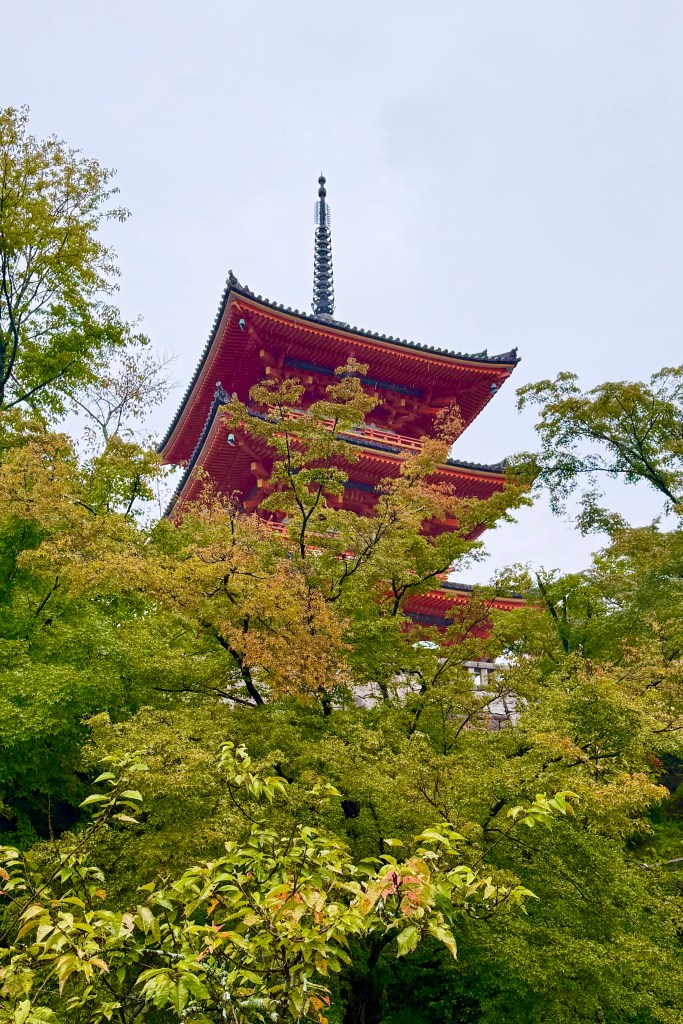
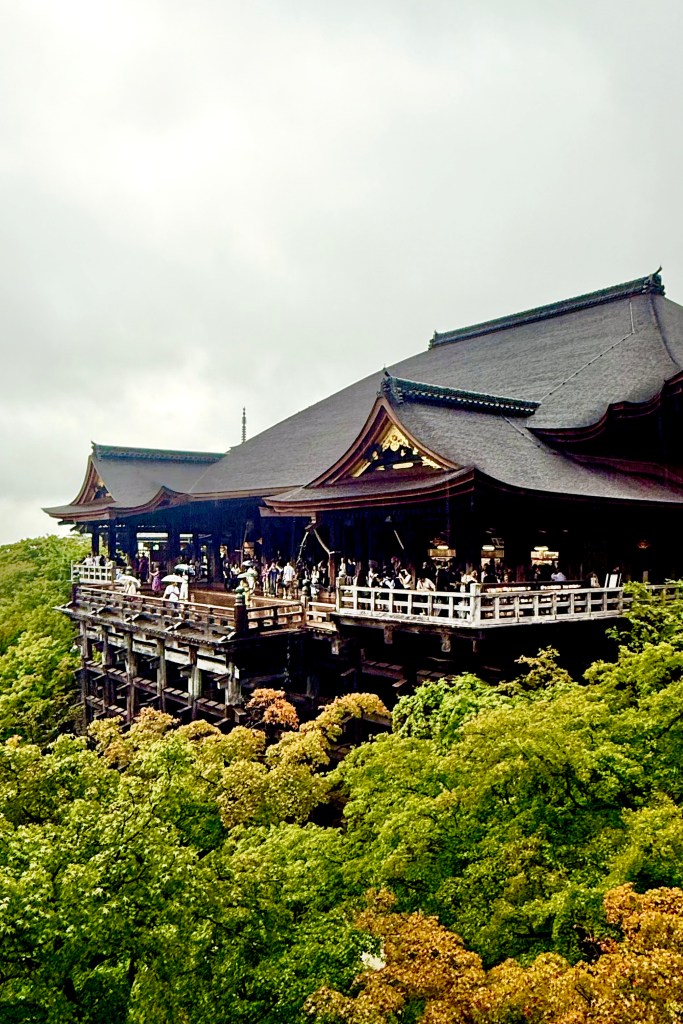
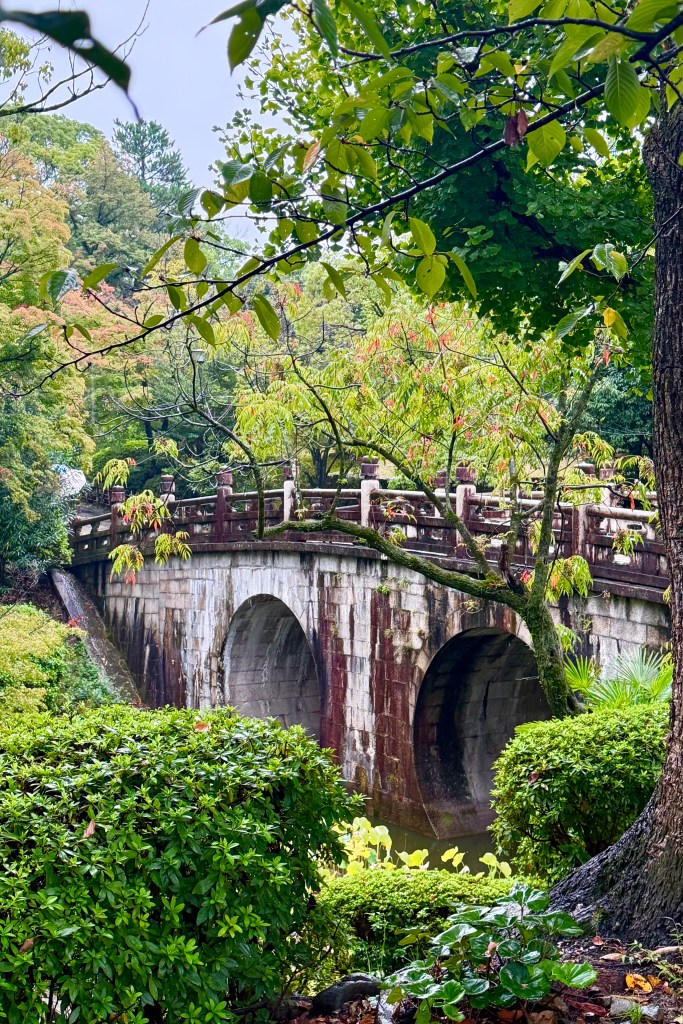
A taxi takes us up into the hills of eastern Kyoto to this one of the city’s most celebrated Buddhist temple complexes. Despite the rain, the place is packed. Kiyomizu-dera was founded in 778, centered around the spring at Otowa Falls. Fires destroyed it again and again over the centuries, so most of what we see today dates from a 1633 reconstruction. Its famous wooden stage juts out over the hillside. About 13 meters above the slope. Held together by an interlocking wooden framework without nails. From here the city usually spreads out below, but today the view is softened by sheets of rain and mist. After making our way through the complex, we start downhill along Sannenzaka and Ninenzaka. Ancient approach streets that have funneled pilgrims to this temple for centuries. Those pilgrims have long since been joined by waves of tourists, and today the narrow stone lanes are wall-to-wall with teahouses, sweet shops, ceramics, and every imaginable souvenir, many tucked inside traditional wooden Kyoto houses. At one turn, Yasaka Pagoda suddenly appears above the old rooftops, a classic Higashiyama view, made even moodier by the storm rolling in.
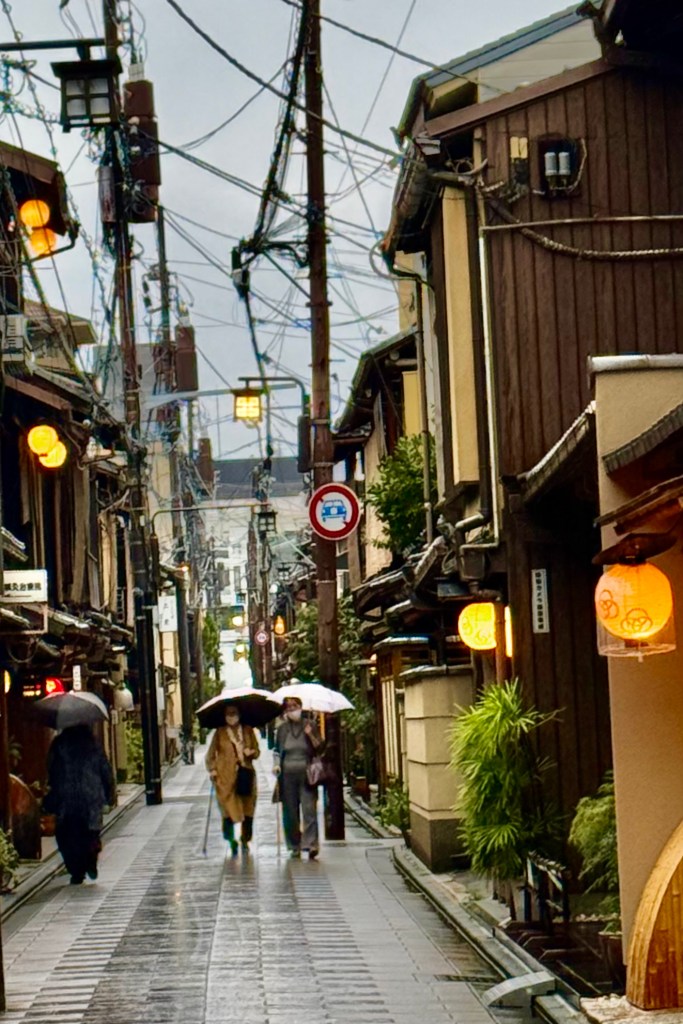
We walk all the way back to our hotel, taking about an hour, umbrellas constantly in use. We stroll through some wonderful old residential districts of Kyoto. And we decide to check out the Irish pub next to our hotel.
Unfortunately, much to our surprise — and disgust — smoking is still allowed, and the place was dense with a nauseating haze. The very lovely barista behind the bar, a woman, said, “oh, the non-smoking section is over there.” But of course, a “non-smoking section” inside a bar full of smoke, doesn’t make much sense. So even though the Irish pub is what we consider to be the international sign of welcome, we decided to come back to our lovely tobacco free Hilton, have a drink, and then decide what we’re going to do for dinner. I have ramen on my mind.
And again: after three taxi rides today, a high speed train from Tokyo and now 10,000 steps through multi and varied neighborhoods: not ONE piece of trash on the ground.